GOB Chemistry
My Course
Learn
Exam Prep
AI Tutor
Study Guides
Textbook Solutions
Flashcards
Explore
My Course
Learn
Exam Prep
AI Tutor
Study Guides
Textbook Solutions
Flashcards
Explore
Back
Gas Evolution Equations (Simplified) quiz
You can tap to flip the card.
Define:
What is a gas evolution equation?
You can tap to flip the card.
👆
What is a gas evolution equation?
A gas evolution equation is a molecular equation that involves the creation of a gas, such as carbon dioxide, from a chemical reaction.
Track progress
Control buttons has been changed to "navigation" mode.
1/15
Related flashcards
Related practice
Recommended videos
Gas Evolution Equations (Simplified) definitions
Gas Evolution Equations (Simplified)
12 Terms
Gas Evolution Equations (Simplified)
10. Acids and Bases
3 problems
Topic

Jules
10. Acids and Bases - Part 1 of 2
6 topics
13 problems
Chapter
Jules
10. Acids and Bases - Part 2 of 2
8 topics
13 problems
Chapter
Jules
Guided course
01:33
Gas Evolution Equations (Simplified) Concept 1
Jules
2538
views
7
rank
Guided course
03:17
Gas Evolution Equations (Simplified) Example 1
Jules
5639
views
23
rank
Terms in this set (15)
Hide definitions
What is a gas evolution equation?
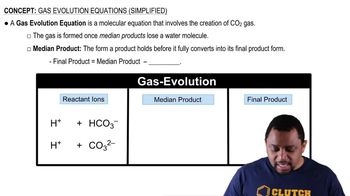
A gas evolution equation is a molecular equation that involves the creation of a gas, such as carbon dioxide, from a chemical reaction.
What is a medium product in a gas evolution equation?
A medium product is an intermediate form that is produced before it fully converts into the final product by losing a water molecule.
Which ions are key reactants in gas evolution equations involving CO2?
The key reactant ions are H+ (hydrogen ion) and the bicarbonate ion.
What is formed when H+ reacts with bicarbonate ion?
When H+ reacts with bicarbonate ion, carbonic acid (H2CO3) is formed as the median product.
Why can't carbonic acid be held as a product in these reactions?
Carbonic acid is unstable and automatically decomposes by losing water to form CO2 gas.
What are the final products when carbonic acid loses water?
The final products are carbon dioxide gas (CO2) and liquid water (H2O).
What happens to the water molecule when carbonic acid decomposes?
The water molecule is released as a liquid while CO2 is released as a gas.
What is the general process for forming CO2 in a gas evolution equation?
The process involves forming carbonic acid as a median product, which then loses water to produce CO2 gas.
What is the chemical formula for carbonic acid?
The chemical formula for carbonic acid is H2CO3.
What is the role of H+ in gas evolution equations?
H+ reacts with bicarbonate or carbonate ions to form carbonic acid, which then decomposes to CO2 and water.
What happens if H+ reacts with carbonate ion instead of bicarbonate?
It still forms carbonic acid as a median product, which then decomposes to CO2 and water.
Why is CO2 considered the final product in these reactions?
CO2 is the final product because it is formed after the median product loses water and cannot revert back.
What physical states are CO2 and H2O in after the reaction?
CO2 is in the gas state and H2O is in the liquid state.
How does the loss of water relate to the formation of gas in these equations?
The loss of water from the median product (carbonic acid) results in the evolution of CO2 gas.
What is the significance of the median product in gas evolution equations?
The median product is crucial because its decomposition by losing water leads to the formation of the gaseous final product.