Skip to main content
GOB Chemistry
My Course
Learn
Exam Prep
AI Tutor
Study Guides
Textbook Solutions
Flashcards
Explore
Try the app
My Course
Learn
Exam Prep
AI Tutor
Study Guides
Textbook Solutions
Flashcards
Explore
Try the app
Back
Gluconeogenesis quiz
You can tap to flip the card.
What is the main purpose of gluconeogenesis?
You can tap to flip the card.
👆
What is the main purpose of gluconeogenesis?
The main purpose of gluconeogenesis is to convert pyruvate into glucose.
Track progress
Control buttons has been changed to "navigation" mode.
1/15
Related flashcards
Related practice
Recommended videos
Gluconeogenesis definitions
Gluconeogenesis
15 Terms
Gluconeogenesis
22. Carbohydrate Metabolism
5 problems
Topic
Nicole
Intro to Gluconeogenesis
22. Carbohydrate Metabolism
2 problems
Topic
Nicole
22. Carbohydrate Metabolism
9 topics
15 problems
Chapter
Nicole
Guided course
1:13
Gluconeogenesis Concept 3
1877
views
Guided course
2:01
Gluconeogenesis Example 5
1812
views
Guided course
1:12
Gluconeogenesis Concept 5
1883
views
Terms in this set (15)
Hide definitions
What is the main purpose of gluconeogenesis?
The main purpose of gluconeogenesis is to convert pyruvate into glucose.
How many biochemical reactions are involved in gluconeogenesis?
Gluconeogenesis involves a total of 11 biochemical reactions.
Which reactions in gluconeogenesis differ from glycolysis?
Reactions 1, 2, 9, and 11 in gluconeogenesis are different from those in glycolysis.
What enzyme catalyzes the conversion of pyruvate to oxaloacetate in gluconeogenesis?
Pyruvate carboxylase catalyzes the conversion of pyruvate to oxaloacetate.
Which enzyme is responsible for converting oxaloacetate to phosphoenolpyruvate (PEP)?
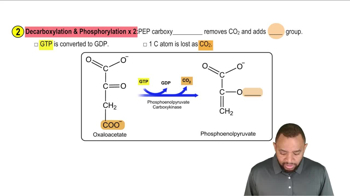
PEP carboxykinase is responsible for converting oxaloacetate to phosphoenolpyruvate (PEP).
What is the role of fructose 1,6-bisphosphatase in gluconeogenesis?
Fructose 1,6-bisphosphatase removes an inorganic phosphate from fructose 1,6-bisphosphate to form fructose 6-phosphate.
Which enzyme catalyzes the final step of gluconeogenesis, forming glucose?
Glucose 6-phosphatase catalyzes the final step, removing a phosphate from glucose 6-phosphate to form glucose.
What energy molecules are required for gluconeogenesis?
Gluconeogenesis requires ATP, GTP, and NADH to drive its reactions.
What mnemonic helps remember the reactions in gluconeogenesis that differ from glycolysis?
The mnemonic 'call 911' helps remember that reactions 1, 2, 9, and 11 are different.
What is the sequence of key metabolites in gluconeogenesis according to the mnemonic?
The sequence is pyruvate, oxaloacetate, PEP, fructose 1,6-bisphosphate, fructose 6-phosphate, glucose 6-phosphate, and glucose.
How does the Cori cycle connect muscle and liver metabolism?
The Cori cycle transports lactate from muscles to the liver, where it is converted back to glucose via gluconeogenesis.
Which reactions in gluconeogenesis involve the use of ATP or GTP?
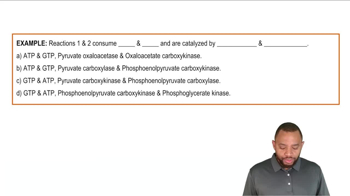
Reaction 1 uses ATP, reaction 2 uses GTP, and reaction 5 uses ATP.
What class of enzyme is responsible for transferring phosphate groups in gluconeogenesis?
Kinases are the class of enzymes responsible for transferring phosphate groups.
What is the function of isomerase enzymes in gluconeogenesis?
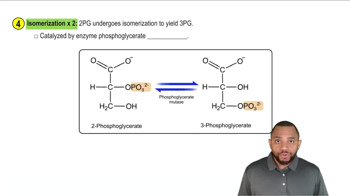
Isomerase enzymes catalyze the rearrangement of molecules to form isomers, such as converting fructose 6-phosphate to glucose 6-phosphate.
How does glycerol enter the gluconeogenesis pathway?
Glycerol enters gluconeogenesis as dihydroxyacetone phosphate (DHAP), bypassing the pyruvate step.
 BackBack
 1:13
1:13