GOB Chemistry
My Course
Learn
Exam Prep
AI Tutor
Study Guides
Textbook Solutions
Flashcards
Explore
My Course
Learn
Exam Prep
AI Tutor
Study Guides
Textbook Solutions
Flashcards
Explore
Back
Intensive vs. Extensive Properties quiz
You can tap to flip the card.
Define:
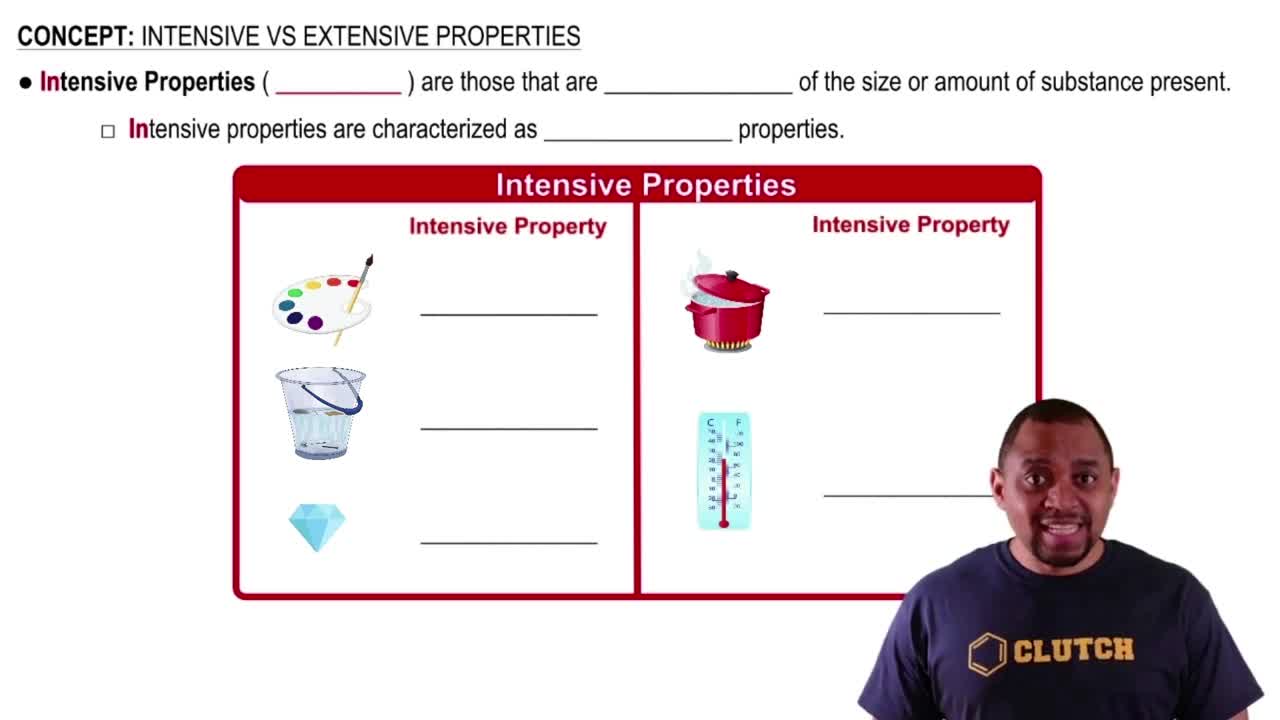
What is an intensive property?
You can tap to flip the card.
👆
What is an intensive property?
An intensive property is a physical property that does not depend on the amount or size of the substance present.
Track progress
Control buttons has been changed to "navigation" mode.
1/15
Related flashcards
Related practice
Recommended videos
Intensive vs. Extensive Properties definitions
Intensive vs. Extensive Properties
14 Terms
Temperature (Simplified)
1. Matter and Measurements
4 problems
Topic

Jules
1. Matter and Measurements - Part 1 of 3
7 topics
15 problems
Chapter
Jules
1. Matter and Measurements - Part 2 of 3
7 topics
15 problems
Chapter
Jules
1. Matter and Measurements - Part 3 of 3
7 topics
15 problems
Chapter
Ernest
Guided course
02:45
Intensive vs. Extensive Properties
Jules
9436
views
118
rank
Guided course
01:58
Intensive vs. Extensive Properties Example 1
Jules
7320
views
96
rank
Guided course
02:04
Intensive vs. Extensive Properties
Jules
7276
views
82
rank
Terms in this set (15)
Hide definitions
What is an intensive property?
An intensive property is a physical property that does not depend on the amount or size of the substance present.
Give two examples of intensive properties.
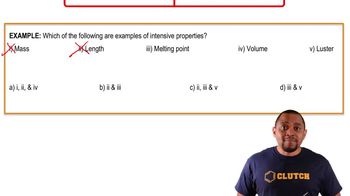
Examples include color and density.
Why is the color of gold considered an intensive property?
The color of gold remains the same regardless of the quantity, making it an intensive property.
Does the boiling point of water change with the amount of water present?
No, water boils at 100 degrees Celsius regardless of the amount, so boiling point is an intensive property.
What is an extensive property?
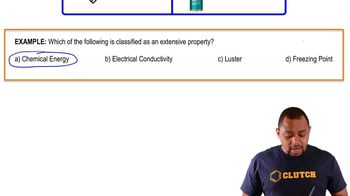
An extensive property is a physical property that depends on the size or amount of the substance present.
List two examples of extensive properties.
Examples include mass and volume.
Why is mass considered an extensive property?
Mass changes depending on the amount of substance, so it is an extensive property.
Is hardness an intensive or extensive property?
Hardness is an intensive property because it does not depend on the amount of the substance.
Does the length of a substance depend on its amount?
Yes, length is an extensive property because it changes with the size or amount.
Is energy an intensive or extensive property?
Energy is an extensive property because it depends on the amount of substance present.
What property determines if an object will sink or float in a liquid?
Density, which is an intensive property, determines if an object will sink or float.
Does the hardness of a diamond change with its size?
No, the hardness of a diamond is the same regardless of its size, making it an intensive property.
Is temperature an intensive or extensive property?
Temperature is an intensive property because it does not depend on the amount of substance.
How does volume relate to the amount of substance?
Volume is an extensive property because it changes with the amount of substance present.
Are both intensive and extensive properties considered physical properties?
Yes, both intensive and extensive properties are types of physical properties.