Back

Intermolecular Forces (Simplified) quiz

Control buttons has been changed to "navigation" mode.
1/15
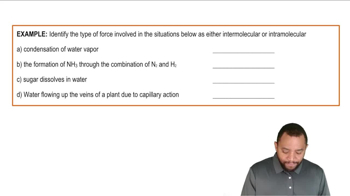
  • What is the main difference between intramolecular and intermolecular forces?

    Intramolecular forces exist within a molecule and hold atoms together, while intermolecular forces are attractions between separate molecules.
  • Which type of force is generally stronger: intramolecular or intermolecular?

    Intramolecular forces are stronger than intermolecular forces.
  • What physical property do intermolecular forces primarily influence?

    Intermolecular forces primarily influence the physical properties of substances, such as boiling and melting points.
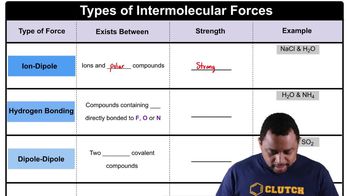
  • What is the strongest type of intermolecular force?

    The strongest type of intermolecular force is the ion-dipole force.
  • Between which types of particles do ion-dipole forces occur?

    Ion-dipole forces occur between ions and polar compounds.
  • What is an example of a situation where ion-dipole forces are significant?

    Ion-dipole forces are significant when an ionic compound, like sodium chloride, is dissolved in water.
  • What is required for hydrogen bonding to occur between molecules?

    Hydrogen bonding occurs when hydrogen is directly bonded to fluorine, oxygen, or nitrogen.
  • How is hydrogen bonding represented in diagrams?

    Hydrogen bonding is represented by a dotted line between the hydrogen atom of one molecule and the F, O, or N atom of another.
  • What type of intermolecular force is hydrogen bonding considered a special case of?

    Hydrogen bonding is considered a special type of dipole-dipole interaction.
  • Between what types of molecules do dipole-dipole forces occur?

    Dipole-dipole forces occur between polar covalent molecules.
  • What is the weakest type of intermolecular force?

    The weakest type of intermolecular force is the London dispersion force.
  • What causes London dispersion forces to arise between molecules?

    London dispersion forces arise from temporary dipoles created when nonpolar molecules come into close proximity.
  • Are London dispersion forces present in all compounds?

    Yes, London dispersion forces are present in all compounds, regardless of their polarity.
  • What is another name for London dispersion forces?

    London dispersion forces are also known as van der Waals forces.
  • Why are London dispersion forces important even though they are weak?

    London dispersion forces are important because they contribute to the properties of all substances, including those with stronger intermolecular forces.