Back

Ionic Bonding definitions

Control buttons has been changed to "navigation" mode.
1/13
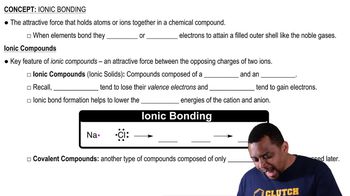
  • Ionic Bonding

    Attractive force holding together oppositely charged ions, resulting in the formation of stable compounds.
  • Cation

    Positively charged species formed when a metal atom loses one or more electrons.
  • Anion

    Negatively charged species produced when a nonmetal atom gains one or more electrons.
  • Ionic Compound

    Substance composed of cations and anions held together by strong electrostatic attractions.
  • Ionic Salt

    Another term for a compound formed from the combination of cations and anions.
  • Electrostatic Attraction

    Force responsible for holding together particles with opposite electrical charges.
  • Valence Electrons

    Outer shell electrons involved in the transfer process during the formation of charged ions.
  • Potential Energy

    Energy lowered when oppositely charged ions come together to form a stable structure.
  • Physical State

    Condition in which ionic compounds exist at room temperature, typically as solids.
  • Conductivity

    Ability of dissolved ionic compounds to allow the flow of electric current due to mobile ions.
  • Melting Point

    Temperature at which an ionic solid transitions to a liquid, usually very high due to strong attractions.
  • Boiling Point

    Temperature required for an ionic solid to become a gas, reflecting strong interionic forces.
  • Brittleness

    Tendency of ionic solids to crack or splinter when subjected to force, despite their hardness.