Back

Ionic Bonding quiz

Control buttons has been changed to "navigation" mode.
1/15
  • What is the main attractive force in ionic bonding?

    The main attractive force in ionic bonding is the electrostatic attraction between oppositely charged ions (cations and anions).
  • What do we call a positively charged ion in an ionic compound?

    A positively charged ion in an ionic compound is called a cation.
  • What do we call a negatively charged ion in an ionic compound?

    A negatively charged ion in an ionic compound is called an anion.
  • How do metals typically form cations?

    Metals form cations by losing their valence electrons.
  • How do nonmetals typically form anions?

    Nonmetals form anions by gaining electrons.
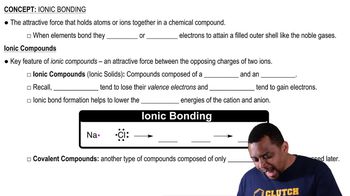
  • Why do sodium (Na) and chlorine (Cl) form an ionic bond?

    Sodium loses an electron to become Na+, and chlorine gains that electron to become Cl-, resulting in opposite charges that attract each other.
  • What is the chemical formula for the ionic compound formed by sodium and chlorine?

    The chemical formula is NaCl.
  • What physical state do most ionic compounds exist in at room temperature?

    Most ionic compounds exist as solids at room temperature.
  • Why do ionic compounds have high melting and boiling points?

    Ionic compounds have high melting and boiling points due to the strong attractive forces between the ions.
  • What happens to the conductivity of ionic compounds when they are dissolved in water?

    When dissolved in water, ionic compounds conduct electricity because the ions become mobile.
  • How would you describe the hardness and brittleness of ionic solids?

    Ionic solids are hard but brittle, meaning they can splinter or crack when force is applied.
  • What is the main reason ionic solids are brittle?

    Ionic solids are brittle because the arrangement of oppositely charged ions can shift and repel each other when force is applied, causing the solid to crack.
  • What is another name for ionic compounds?

    Ionic compounds are also called ionic salts.
  • What is the role of electron transfer in ionic bonding?

    Electron transfer allows metals to become cations and nonmetals to become anions, enabling the formation of ionic bonds.
  • How does ionic bond formation affect the potential energy of the ions involved?

    Ionic bond formation lowers the potential energy of the cation and anion involved.