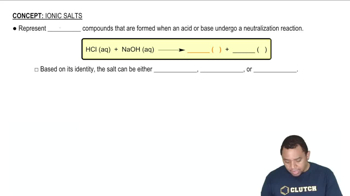
What is a salt in the context of acid-base reactions?
A salt is the ionic compound formed as a product of the neutralization between an acid and a base, consisting of a cation and an anion.
What are the two products typically formed when an acid and a base neutralize each other?
The two products are water and a salt.
What determines whether a salt will make a solution acidic, basic, or neutral?
The properties of the cation and anion in the salt determine if the solution will be acidic, basic, or neutral.
How are cations in salts categorized?
Cations are categorized as transition metals, main group metals, or positive amines.
What is the rule for acidity of transition metal cations in salts?
Transition metal cations are acidic if their charge is +2 or higher; otherwise, they are neutral.
Give an example of an acidic and a neutral transition metal salt.
Zinc chloride (ZnCl2) is acidic, while silver bromide (AgBr) is neutral.
What is the rule for main group metal cations regarding acidity?
Main group metal cations are acidic if their charge is +3 or higher; otherwise, they are neutral.
Why are Group 1a and 2a metals always neutral in salts?
Group 1a and 2a metals have charges of +1 and +2, which do not meet the minimum requirement for acidity, so they are always neutral.
What is special about tin (Sn) and lead (Pb) in group 4a regarding their charges?
Tin and lead can have charges of +2 or +4; they are neutral at +2 and acidic at +4.
Are positive amines in salts acidic or neutral?
Positive amines are always acidic in salts.
How can you identify a salt containing a positive amine?
A salt with a positive amine will have a cation containing nitrogen and hydrogen (or carbon, hydrogen, and nitrogen) and a negative anion.
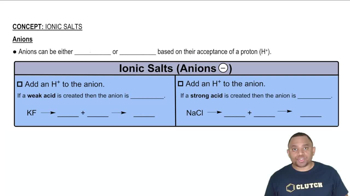
How do you determine if an anion is basic or neutral?
Add H+ to the anion; if it forms a weak acid, the anion is basic, but if it forms a strong acid, the anion is neutral.
What type of acid does BrO- form when H+ is added, and what does this mean for its basicity?
BrO- forms a weak oxyacid (HBrO) when H+ is added, so BrO- is basic.
What type of acid does Br- form when H+ is added, and what does this mean for its basicity?
Br- forms a strong binary acid (HBr) when H+ is added, so Br- is neutral.
Why is it important to focus on the anion when determining the acidity or basicity of a salt?
Because the basicity or neutrality of the anion depends on the strength of the acid it forms with H+, which can be more complex to determine than for cations.
 Back
Back
 01:20
01:20