Back

Ions (Simplified) quiz

Control buttons has been changed to "navigation" mode.
1/15
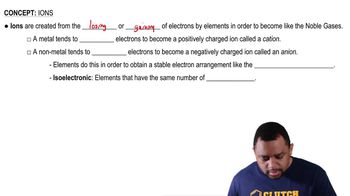
  • What is the main reason elements form ions?

    Elements form ions to achieve a stable electron arrangement like the noble gases.
  • What type of ion do metals typically form?

    Metals typically form positively charged ions called cations.
  • What type of ion do nonmetals typically form?

    Nonmetals typically form negatively charged ions called anions.
  • What does the term 'isoelectronic' mean?

    Isoelectronic means having the same number of electrons.
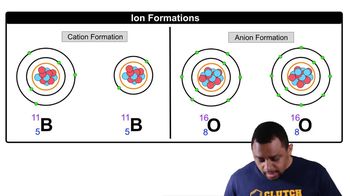
  • How is a cation formed?

    A cation is formed when an atom loses electrons.
  • How is an anion formed?

    An anion is formed when an atom gains electrons.
  • What happens to the charge of an atom when it loses electrons?

    The atom becomes more positively charged for each electron it loses.
  • What happens to the charge of an atom when it gains electrons?

    The atom becomes more negatively charged for each electron it gains.
  • How many electrons does neutral boron have?

    Neutral boron has 5 electrons.
  • What is the charge of boron after it loses 3 electrons?

    After losing 3 electrons, boron has a charge of 3+.
  • How many electrons does neutral oxygen have?

    Neutral oxygen has 8 electrons.
  • What is the charge of oxygen after it gains 2 electrons?

    After gaining 2 electrons, oxygen has a charge of 2-.
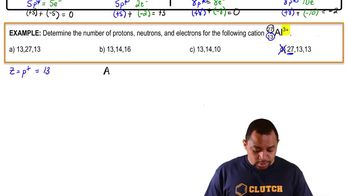
  • What does the atomic number of an element represent?

    The atomic number represents the number of protons in the nucleus.
  • What does the mass number of an element represent?

    The mass number is the total number of protons and neutrons in the nucleus.
  • Why does gaining electrons make an atom negatively charged?

    Gaining electrons increases the number of negatively charged particles, making the atom negatively charged.