Back

Le Chatelier's Principle quiz

Control buttons has been changed to "navigation" mode.
1/15
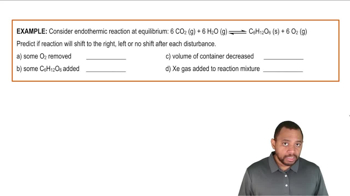
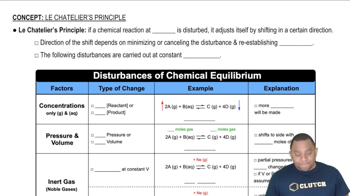
  • What does Le Chatelier's Principle state about a system at equilibrium when it is disturbed?

    It states that the system will shift in a direction that minimizes or cancels the disturbance to reestablish equilibrium.
  • How does increasing the concentration of reactants affect the direction of equilibrium?

    Increasing reactants shifts the equilibrium forward, toward the products, to reduce the excess reactants.
  • What happens to equilibrium if you decrease the concentration of products?

    The equilibrium shifts forward, toward the products, to replenish the depleted products.
  • When pressure is increased in a reaction involving gases, which side does the equilibrium shift toward?

    It shifts toward the side with fewer moles of gas.
  • How does decreasing the volume of a gaseous reaction mixture affect equilibrium?

    Decreasing volume increases pressure, causing the equilibrium to shift toward the side with fewer moles of gas.
  • What is the effect of adding an inert gas at constant volume on the equilibrium position?

    Adding an inert gas at constant volume causes no shift in the equilibrium position.
  • If an inert gas is added at constant pressure, how does the equilibrium shift?

    The equilibrium shifts toward the side with more moles of gas because the volume increases.
  • What effect does adding a catalyst have on the position of equilibrium?

    A catalyst does not shift the equilibrium position; it only speeds up the rate at which equilibrium is reached.
  • How does decreasing the concentration of reactants affect the equilibrium?

    Decreasing reactants shifts the equilibrium toward the reactants to produce more reactants.
  • What happens to equilibrium if you increase the concentration of products?

    Increasing products shifts the equilibrium toward the reactants to reduce the excess products.
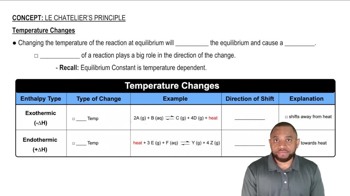
  • How does increasing temperature affect an exothermic reaction at equilibrium?

    Increasing temperature shifts the equilibrium away from the heat, toward the reactants in an exothermic reaction.
  • In an endothermic reaction, what is the effect of decreasing temperature on equilibrium?

    Decreasing temperature shifts the equilibrium toward the heat, which is the reactant side in an endothermic reaction.
  • Why is it important to know if a reaction is endothermic or exothermic when considering temperature changes?

    Because the location of heat (reactant or product side) determines the direction the equilibrium will shift when temperature changes.
  • What happens to the equilibrium constant (K) when temperature changes?

    The equilibrium constant (K) changes because it is temperature dependent.
  • If pressure is decreased or volume is increased in a gaseous equilibrium, which side does the equilibrium favor?

    The equilibrium shifts toward the side with more moles of gas.