GOB Chemistry
My Course
Learn
Exam Prep
AI Tutor
Study Guides
Textbook Solutions
Flashcards
Explore
My Course
Learn
Exam Prep
AI Tutor
Study Guides
Textbook Solutions
Flashcards
Explore
Back
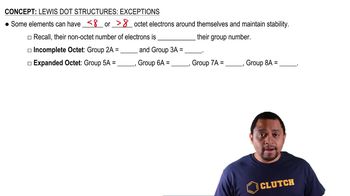
Lewis Dot Structures: Exceptions (Simplified) definitions
You can tap to flip the card.
Define:
Octet Rule
You can tap to
flip the card.
👆
Octet Rule
A guideline stating atoms tend to surround themselves with eight electrons for stability, though exceptions exist.
Track progress
Control buttons has been changed to "navigation" mode.
1/13
Related practice
Recommended videos
Guided course
00:52
Lewis Dot Structures: Exceptions (Simplified) Concept 1
Jules
4903
views
34
rank
Guided course
01:46
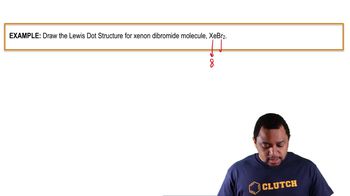
Lewis Dot Structures: Exceptions (Simplified) Example 1
Jules
4869
views
30
rank
Guided course
01:38
Lewis Dot Structures: Exceptions (Simplified) Concept 2
Jules
1380
views
9
rank
Terms in this set (13)
Hide definitions
Octet Rule
A guideline stating atoms tend to surround themselves with eight electrons for stability, though exceptions exist.
Incomplete Octet
A situation where an atom is stable with fewer than eight electrons, common in certain groups like 2A and 3A.
Expanded Octet
A condition where an atom is stable with more than eight electrons, often seen in higher group elements.
Group Number
A value used to predict the typical number of valence electrons and possible exceptions to the octet rule.
Valence Electrons
The outermost electrons involved in bonding and determining molecular stability and structure.
Lewis Dot Structure
A diagram showing valence electrons as dots around atomic symbols, used to visualize bonding and exceptions.
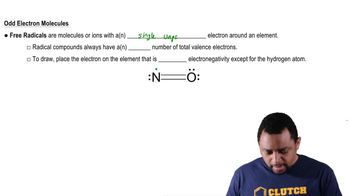
Free Radical
A molecule or ion containing a single unpaired electron, resulting in an odd total number of valence electrons.
Radical Compound
A chemical species with an odd number of valence electrons, often highly reactive due to an unpaired electron.
Electronegativity
A measure of an atom's tendency to attract electrons, influencing electron placement in radicals.
Duet Rule
A stability guideline for hydrogen, which prefers only two electrons in its valence shell.
Nitrogen Monoxide
A molecule with 11 valence electrons, featuring an unpaired electron on nitrogen due to its lower electronegativity.
Lone Electron
A single unpaired electron present in a molecule, characteristic of free radicals.
Stability
A state where an atom or molecule maintains a preferred electron arrangement, even when the octet rule is broken.