GOB Chemistry
My Course
Learn
Exam Prep
AI Tutor
Study Guides
Textbook Solutions
Flashcards
Explore
My Course
Learn
Exam Prep
AI Tutor
Study Guides
Textbook Solutions
Flashcards
Explore
Back
Lewis Dot Structures: Multiple Bonds quiz
You can tap to flip the card.
Define:
Why do atoms form multiple bonds?
You can tap to flip the card.
👆
Why do atoms form multiple bonds?
Atoms form multiple bonds when valence electrons are not enough to satisfy the octet rule, aiming for 8 electrons around each atom.
Track progress
Control buttons has been changed to "navigation" mode.
1/15
Related flashcards
Related practice
Recommended videos
Lewis Dot Structures: Multiple Bonds definitions
Lewis Dot Structures: Multiple Bonds
11 Terms
Lewis Dot Structures: Multiple Bonds
4. Molecular Compounds
3 problems
Topic

Jules
Lewis Dot Structures: Ions (Simplified)
4. Molecular Compounds
2 problems
Topic
Jules
4. Molecular Compounds - Part 1 of 2
8 topics
13 problems
Chapter
Jules
4. Molecular Compounds - Part 2 of 2
8 topics
12 problems
Chapter
Jules
Guided course
01:57
Lewis Dot Structures: Multiple Bonds Concept 1
Jules
2951
views
12
rank
Guided course
02:55
Lewis Dot Structures: Multiple Bonds Example 1
Jules
2818
views
14
rank
Terms in this set (15)
Hide definitions
Why do atoms form multiple bonds?
Atoms form multiple bonds when valence electrons are not enough to satisfy the octet rule, aiming for 8 electrons around each atom.
What is the octet rule?
The octet rule states that atoms ideally want 8 electrons around them to achieve a noble gas electron arrangement.
How many electrons are shared in a single covalent bond?
A single covalent bond shares 2 electrons between two atoms.
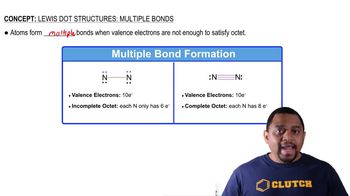
Why does a single bond between two nitrogen atoms not satisfy the octet rule?
Each nitrogen atom only has 6 electrons around it with a single bond, which is less than the 8 required by the octet rule.
How many valence electrons are used in the N2 molecule, regardless of bond type?
The N2 molecule uses a total of 10 valence electrons, whether it has a single or triple bond.
How many electrons does each nitrogen atom have around it in N2 with a triple bond?
Each nitrogen atom has 8 electrons around it when N2 has a triple bond, satisfying the octet rule.
What is the purpose of creating double or triple bonds in Lewis structures?
Double or triple bonds are created to help atoms fulfill the octet rule when single bonds are insufficient.
How many electrons are in a triple bond?
A triple bond consists of 6 shared electrons between two atoms.
What rule does hydrogen follow instead of the octet rule?
Hydrogen follows the duet rule, seeking only 2 electrons to resemble helium.
Why is hydrogen an exception to the octet rule?
Hydrogen only needs 2 electrons to achieve a stable electron configuration, unlike most other elements that need 8.
What is the electron arrangement goal for most atoms in Lewis structures?
Most atoms aim for 8 electrons around them to resemble noble gas electron arrangements.
How are electrons shared in covalent bonds?
Electrons in covalent bonds are shared between the bonded atoms.
What happens if an atom has an incomplete octet in a Lewis structure?
If an atom has an incomplete octet, multiple bonds may be needed to provide enough electrons.
How do you count the electrons around an atom in a Lewis structure?
Count both the shared electrons in bonds and the lone pairs around the atom.
What is the main difference between single, double, and triple bonds in terms of electron sharing?
Single bonds share 2 electrons, double bonds share 4, and triple bonds share 6 electrons between atoms.