Skip to main content
GOB Chemistry
My Course
Learn
Exam Prep
AI Tutor
Study Guides
Textbook Solutions
Flashcards
Explore
Try the app
My Course
Learn
Exam Prep
AI Tutor
Study Guides
Textbook Solutions
Flashcards
Explore
Try the app
Back
Limiting Reagent quiz
You can tap to flip the card.
What is the limiting reagent in a chemical reaction?
You can tap to flip the card.
👆
What is the limiting reagent in a chemical reaction?
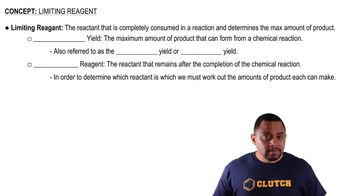
The limiting reagent is the reactant that is completely consumed in a reaction and determines the maximum amount of product formed.
Track progress
Control buttons has been changed to "navigation" mode.
1/15
Related flashcards
Related practice
Recommended videos
Limiting Reagent definitions
Limiting Reagent
14 Terms
Limiting Reagent
6. Chemical Reactions & Quantities
5 problems
Topic
Jules
Percent Yield
6. Chemical Reactions & Quantities
4 problems
Topic
Jules
6. Chemical Reactions & Quantities - Part 1 of 2
6 topics
9 problems
Chapter
Jules
6. Chemical Reactions & Quantities - Part 2 of 2
3 topics
8 problems
Chapter
Jules
Guided course
01:30
Limiting Reagent
11965
views
100
rank
Guided course
6:38
Limiting Reagent Example
192
views
2
rank
Guided course
01:34
Limiting Reagent
10399
views
88
rank
Terms in this set (15)
Hide definitions
What is the limiting reagent in a chemical reaction?
The limiting reagent is the reactant that is completely consumed in a reaction and determines the maximum amount of product formed.
What does the limiting reagent determine in a chemical reaction?
It determines the theoretical yield, which is the maximum amount of product that can be formed.
What is another name for the limiting reagent?
The limiting reagent is also called the limiting reactant.
What is the excess reagent in a chemical reaction?
The excess reagent is the reactant that remains after the reaction is complete.
Why do we need to perform stoichiometry for each reactant when given multiple reactants?
We need to perform stoichiometry for each reactant to determine which one limits the reaction and which one is in excess.
What is the theoretical yield?
The theoretical yield is the maximum amount of product that can be formed from a chemical reaction, based on the limiting reagent.
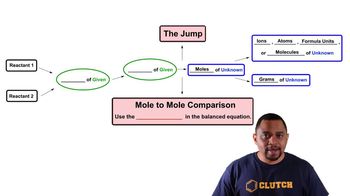
How do you convert the given amount of a reactant in grams to moles?
You convert grams to moles by dividing the mass of the reactant by its molar mass.
What role do the coefficients in a balanced equation play in limiting reagent problems?
The coefficients are used to relate the moles of reactants to the moles of products in stoichiometric calculations.
How do you determine which reactant is the limiting reagent?
You calculate the amount of product each reactant can produce and the one that produces the least is the limiting reagent.
What happens to the excess reagent after the reaction is complete?
The excess reagent remains unreacted after the reaction is complete.
Why is it necessary to do stoichiometric calculations for each reactant in limiting reagent problems?
It's necessary to identify which reactant limits the reaction and to calculate the theoretical yield.
What is meant by 'double the work' in limiting reagent problems?
It means you must perform stoichiometric calculations for each reactant to determine the limiting reagent and theoretical yield.
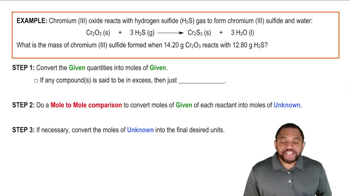
What is the first step in solving a limiting reagent problem when given masses of reactants?
The first step is to convert the given masses of reactants to moles.
After finding the moles of product from each reactant, what do you do next?
You compare the amounts to determine which reactant produces the least product; that reactant is the limiting reagent.
Why is the limiting reagent important in chemical reactions?
It determines the maximum amount of product that can be formed and when the reaction will stop.
 BackBack
 01:30
01:30