Skip to main content
GOB Chemistry
My Course
Learn
Exam Prep
AI Tutor
Study Guides
Textbook Solutions
Flashcards
Explore
Try the app
My Course
Learn
Exam Prep
AI Tutor
Study Guides
Textbook Solutions
Flashcards
Explore
Try the app
Back
Membrane Transport definitions
You can tap to flip the card.
Membrane Transport
You can tap to flip the card.
👆
Membrane Transport
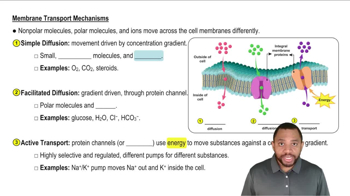
Cellular process enabling exchange of substances with the extracellular fluid, crucial for nutrient uptake and waste removal.
Track progress
Control buttons has been changed to "navigation" mode.
1/15
Related flashcards
Related practice
Recommended videos
Membrane Transport quiz
Membrane Transport
15 Terms
Membrane Transport
23. Lipids
5 problems
Topic
Nicole
Cell Membranes
23. Lipids
3 problems
Topic
Nicole
23. Lipids - Part 1 of 3
6 topics
13 problems
Chapter
Ernest
23. Lipids - Part 2 of 3
6 topics
12 problems
Chapter
Nicole
23. Lipids - Part 3 of 3
1 topic
3 problems
Chapter
Guided course
0:53
Membrane Transport Example 2
3195
views
Guided course
3:01
Membrane Transport Concept 2
3183
views
Guided course
1:21
Membrane Transport Example 1
3211
views
1
rank
Terms in this set (15)
Hide definitions
Membrane Transport
Cellular process enabling exchange of substances with the extracellular fluid, crucial for nutrient uptake and waste removal.
Passive Transport
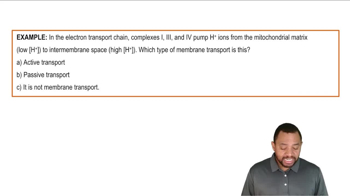
Movement of substances across the membrane without energy input, always following the concentration gradient.
Active Transport
Energy-dependent movement of substances across the membrane, allowing passage against the concentration gradient.
Concentration Gradient
Difference in substance concentration across a distance, driving the direction of molecular movement.
Simple Diffusion
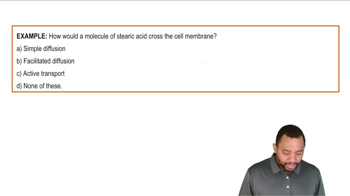
Direct passage of small, non-polar molecules or water through the lipid bilayer, requiring no assistance.
Facilitated Diffusion
Transport of polar molecules or ions via protein channels, allowing movement down the concentration gradient.
Lipid Bilayer
Double-layered membrane structure forming the cell boundary, selectively permeable to various substances.
Protein Channel
Integral membrane structure providing a passageway for specific molecules or ions to cross the cell membrane.
Integral Protein
Membrane-spanning protein essential for facilitating the movement of substances across the lipid bilayer.
Sodium Potassium Pump
Membrane protein complex using energy to exchange sodium and potassium ions, maintaining cellular ion balance.
Extracellular Fluid
Liquid environment outside the cell, serving as the medium for substance exchange during membrane transport.
Polar Molecule
Substance with uneven charge distribution, often requiring protein channels for membrane passage.
Non-polar Molecule
Substance with even charge distribution, able to cross the lipid bilayer without assistance.
Ion
Charged particle, such as chloride or bicarbonate, typically requiring facilitated diffusion or active transport.
Pump
Membrane protein utilizing energy to move substances against their concentration gradients, ensuring selective transport.
 BackBack

 0:53
0:53