Back

Molality quiz

Control buttons has been changed to "navigation" mode.
1/15
  • What is the formula for molality?

    Molality is calculated as moles of solute divided by kilograms of solvent.
  • How does molality differ from molarity?

    Molality uses kilograms of solvent in the denominator, while molarity uses liters of solution.
  • What does a molality of 0.30 m mean?

    It means there are 0.30 moles of solute per 1 kilogram of solvent.
  • In a 0.25 molal glucose solution, what is the solvent and its amount?

    The solvent is water, and its amount is 1 kilogram.
  • What is osmolality (ionic molality)?

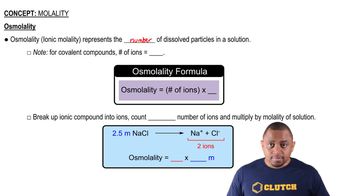
    Osmolality is the number of dissolved particles (ions) in a solution, calculated as the number of ions times the molality.
  • How do you calculate osmolality for ionic compounds?

    Multiply the number of ions the compound dissociates into by the molality of the solution.
  • How many ions does sodium chloride dissociate into?

    Sodium chloride dissociates into 2 ions: sodium and chloride.
  • What is the osmolality of a 0.30 molal NaCl solution?

    The osmolality is 0.60 osmolal (2 ions × 0.30 molal).
  • How many ions does a covalent compound contribute to osmolality?

    A covalent compound contributes 1 ion because it does not dissociate.
  • What is the osmolality of a 2.5 molal NaCl solution?

    The osmolality is 5 osmolal (2 ions × 2.5 molal).
  • Why is it important to consider the number of dissociated ions in osmolality?

    Because osmolality depends on the total number of dissolved particles, not just the amount of compound.
  • What does 'aqueous solution' mean in the context of molality?

    It means the solvent is water.
  • What is the unit for molality?

    The unit for molality is moles per kilogram (mol/kg).
  • How would you convert molality to osmolality for a compound that does not dissociate?

    For a non-dissociating compound, osmolality equals molality because the number of ions is 1.
  • What is the key difference in calculating molality for ionic versus covalent compounds?

    For ionic compounds, you multiply by the number of ions formed; for covalent compounds, you use 1 since they do not dissociate.