Back

Molecular Formula quiz

Control buttons has been changed to "navigation" mode.
1/15
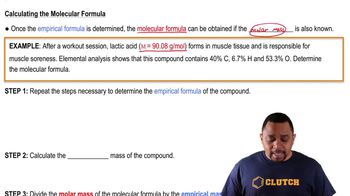
  • What does the molecular formula of a compound represent?

    The molecular formula shows the actual number of each type of atom in a compound.
  • How does the empirical formula differ from the molecular formula?

    The empirical formula gives the simplest whole-number ratio of atoms, while the molecular formula gives the actual number of atoms.
  • What is the 'n factor' used for when determining molecular formulas?

    The n factor is a number used to multiply the subscripts in the empirical formula to get the molecular formula.
  • How do you find the molecular formula if you know the empirical formula and the n factor?

    Multiply each subscript in the empirical formula by the n factor to get the molecular formula.
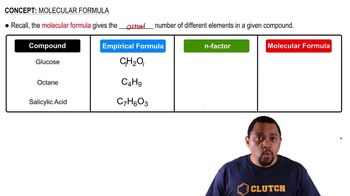
  • What is the molecular formula of glucose if its empirical formula is CH2O and the n factor is 6?

    The molecular formula is C6H12O6.
  • If octane has an empirical formula of C4H9 and an n factor of 2, what is its molecular formula?

    Its molecular formula is C8H18.
  • What does it mean if a compound's n factor is 1?

    It means the empirical formula and the molecular formula are the same.
  • What is the molecular formula of salicylic acid if its empirical formula is C7H6O3 and n factor is 1?

    The molecular formula is C7H6O3.
  • What should you do if you are not given the n factor for a compound?

    You need to use additional methods to determine the n factor, which will be covered in later lessons.
  • Why is the empirical formula sometimes not the same as the molecular formula?

    Because the empirical formula only shows the simplest ratio, not the actual number of atoms present.
  • What information do you need to convert an empirical formula to a molecular formula?

    You need the empirical formula and the n factor.
  • If the empirical formula of a compound is CH2O and the molecular formula is C6H12O6, what is the n factor?

    The n factor is 6.
  • What is the process for finding the molecular formula from the empirical formula?

    Multiply the subscripts in the empirical formula by the n factor.
  • Can the empirical formula ever be the same as the molecular formula?

    Yes, if the n factor is 1.
  • What does the subscript in a chemical formula indicate?

    It indicates the number of atoms of each element in the compound.