Back

Molecular Geometry (Simplified) quiz

Control buttons has been changed to "navigation" mode.
1/15
  • What does molecular geometry take into account that affects the true shape of a molecule?

    Molecular geometry considers differences in repulsion between lone pairs and bonding groups, treating them as different.
  • How many possible molecular geometries exist for a central element with 2 electron groups and 0 lone pairs?

    There is only one possible molecular geometry: linear.
  • Name three molecules that have a linear molecular geometry due to 2 electron groups and 0 lone pairs.

    Beryllium chloride, carbon dioxide, and hydrocyanic acid.
  • Does the type of bond (single, double, triple) affect the count of electron groups for molecular geometry?

    No, each bond counts as one electron group regardless of being single, double, or triple.
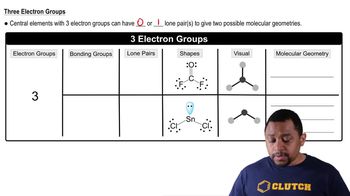
  • What are the two possible molecular geometries for a central element with 3 electron groups?

    Trigonal planar (0 lone pairs) and bent/V-shaped/angular (1 lone pair).
  • What is the molecular geometry called when a central atom has 3 bonding groups and 0 lone pairs?

    Trigonal planar.
  • What is the molecular geometry called when a central atom has 2 bonding groups and 1 lone pair?

    It is called bent, V-shaped, or angular.
  • How do you determine the total number of electron groups around a central atom?

    Add the number of bonding groups and lone pairs together.
  • How many possible molecular geometries are there for a central element with 4 electron groups?

    There are three possible molecular geometries.
  • What is the molecular geometry for a central atom with 4 bonding groups and 0 lone pairs?

    Tetrahedral.
  • What is the molecular geometry for a central atom with 3 bonding groups and 1 lone pair?

    Trigonal pyramidal.
  • What is the molecular geometry for a central atom with 2 bonding groups and 2 lone pairs?

    Bent, V-shaped, or angular.
  • Which molecule is a good example of a tetrahedral molecular geometry?

    Methane (CH4).
  • Which molecule is a good example of a trigonal pyramidal molecular geometry?

    Ammonia (NH3).
  • What happens to the number of possible molecular geometries as the number of electron groups increases?

    The number of possible molecular geometries increases.