GOB Chemistry
My Course
Learn
Exam Prep
AI Tutor
Study Guides
Textbook Solutions
Flashcards
Explore
My Course
Learn
Exam Prep
AI Tutor
Study Guides
Textbook Solutions
Flashcards
Explore
Back
Molecular Models quiz
You can tap to flip the card.
Define:
What do molecular models use to represent different elements and their chemical bonds?
You can tap to flip the card.
👆
What do molecular models use to represent different elements and their chemical bonds?
Molecular models use color-coded balls to represent different elements and their chemical bonds.
Track progress
Control buttons has been changed to "navigation" mode.
1/15
Related flashcards
Related practice
Recommended videos
Molecular Models definitions
Molecular Models
13 Terms
Molecular Models
4. Molecular Compounds
3 problems
Topic

Jules
Bonding Preferences
4. Molecular Compounds
3 problems
Topic
Jules
4. Molecular Compounds - Part 1 of 2
8 topics
13 problems
Chapter
Jules
4. Molecular Compounds - Part 2 of 2
8 topics
12 problems
Chapter
Jules
Guided course
01:10
Molecular Models Concept 1
Jules
3745
views
7
rank
1
comments
Guided course
00:34
Molecular Models Example 1
Jules
3470
views
12
rank
Terms in this set (15)
Hide definitions
What do molecular models use to represent different elements and their chemical bonds?
Molecular models use color-coded balls to represent different elements and their chemical bonds.
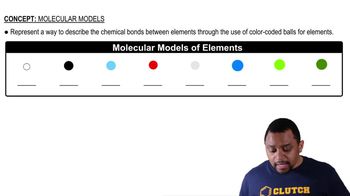
In molecular models, what does a white ball represent?
A white ball represents hydrogen.
Which element is represented by a black ball in molecular models?
A black ball represents carbon.
What color is used to represent nitrogen in molecular models?
Nitrogen is represented by a sky blue ball.
Which color represents oxygen in molecular models?
Oxygen is represented by a red ball.
What element does a grayish off-white ball represent in molecular models?
A grayish off-white ball represents fluorine.
In molecular models, which element is shown with a navy blue ball?
A navy blue ball represents phosphorus.
What color is used for sulfur in molecular models?
Sulfur is represented by a lime green ball.
Which element is represented by a forest green ball in molecular models?
A forest green ball represents chlorine.
Is the size of the balls in molecular models important for identifying elements?
No, the size is not the primary focus; the color is crucial for identifying elements.
Why are colors important in molecular models?
Colors are important because they help identify which element each ball represents.
How are chemical bonds depicted in molecular models?
Chemical bonds are depicted by the connections between the color-coded balls.
What is the main purpose of using color-coded balls in molecular models?
The main purpose is to visually distinguish different elements and their bonds.
Which two elements are represented by shades of green in molecular models?
Sulfur is lime green and chlorine is forest green.
What should you focus on when identifying elements in molecular models: color or size?
You should focus on the color, not the size, to identify elements.