Back

Multiple Bonds (Simplified) quiz

Control buttons has been changed to "navigation" mode.
1/15
  • Why are multiple bonds sometimes necessary in Lewis structures?

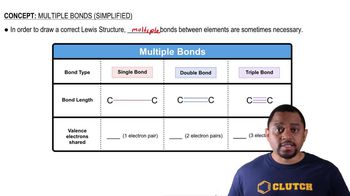
    Multiple bonds are necessary to correctly represent the sharing of electrons between atoms in some molecules.
  • How does bond length change as the number of bonds increases between two atoms?

    Bond length decreases as the number of bonds increases; single bonds are longest, triple bonds are shortest.
  • How many electrons are shared in a single covalent bond?

    A single covalent bond involves sharing 2 electrons between atoms.
  • How many electron pairs are formed in a single bond?

    A single bond forms 1 electron pair.
  • How many valence electrons are shared in a double bond?

    A double bond shares 4 valence electrons between atoms.
  • How many electron pairs are present in a double bond?

    A double bond consists of 2 electron pairs.
  • How many valence electrons are shared in a triple bond?

    A triple bond shares 6 valence electrons between atoms.
  • How many electron pairs are present in a triple bond?

    A triple bond consists of 3 electron pairs.
  • What is the relationship between bond order and bond length?

    Higher bond order (more bonds) results in shorter bond length.
  • What does each covalent bond represent in terms of electrons?

    Each covalent bond represents the sharing of 2 electrons.
  • Which type of bond is the longest: single, double, or triple?

    Single bonds are the longest among the three types.
  • Which type of bond is the shortest: single, double, or triple?

    Triple bonds are the shortest among the three types.
  • How many bonds are present in a triple bond?

    A triple bond consists of 3 individual bonds.
  • How many bonds are present in a double bond?

    A double bond consists of 2 individual bonds.
  • How many bonds are present in a single bond?

    A single bond consists of 1 individual bond.