Back

Mutarotation quiz

Control buttons has been changed to "navigation" mode.
1/15
  • What is mutarotation in monosaccharides?

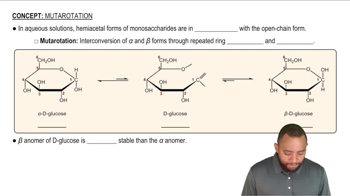
    Mutarotation is the interconversion between the alpha and beta cyclic forms of monosaccharides through ring opening and closing.
  • Which forms of D-glucose are in equilibrium in aqueous solutions?

    The alpha, beta, and open chain forms of D-glucose are in equilibrium in aqueous solutions.
  • What is the anomeric carbon in D-glucose?

    The anomeric carbon is carbon number 1, which forms the hemiacetal in the cyclic structure.
  • What functional group is present at carbon 1 in the open chain form of glucose?

    In the open chain form, carbon 1 has an aldehyde group (double bond O and H).
  • How does the open chain form of glucose relate to the cyclic forms?

    The open chain form can close to form either the alpha or beta cyclic forms, and the cyclic forms can open to revert to the open chain form.
  • Which form of D-glucose is the least stable in aqueous solution?

    The open chain form is the least stable and exists only in trace amounts.
  • What percentage of D-glucose exists in the alpha form in aqueous solution?

    About 36% of D-glucose exists in the alpha form in aqueous solution.
  • What percentage of D-glucose exists in the beta form in aqueous solution?

    Approximately 64% of D-glucose exists in the beta form in aqueous solution.
  • Which form of D-glucose is the most stable in aqueous solution?

    The beta form of D-glucose is the most stable in aqueous solution.
  • What is the process called when the ring form of glucose opens and closes?

    This process is called mutarotation.
  • What is the relationship between the stability of alpha and beta forms of D-glucose?

    The beta form is more stable than the alpha form in aqueous solution.
  • What happens to the percentage of open chain form of D-glucose in water?

    The open chain form exists only in trace amounts, much less than a percentage.
  • What is the significance of the hemiacetal carbon in mutarotation?

    The hemiacetal carbon (anomeric carbon) is where the ring opens and closes, allowing interconversion between alpha and beta forms.
  • How does mutarotation affect the equilibrium of glucose forms?

    Mutarotation allows continuous interconversion, maintaining equilibrium between alpha, beta, and open chain forms.
  • Why is the beta form of D-glucose favored in aqueous solution?

    The beta form is favored because it is more stable than the alpha and open chain forms.