Skip to main content
GOB Chemistry
My Course
Learn
Exam Prep
AI Tutor
Study Guides
Textbook Solutions
Flashcards
Explore
Try the app
My Course
Learn
Exam Prep
AI Tutor
Study Guides
Textbook Solutions
Flashcards
Explore
Try the app
Back
Naming Acids definitions
You can tap to flip the card.
Acid
You can tap to flip the card.
👆
Acid
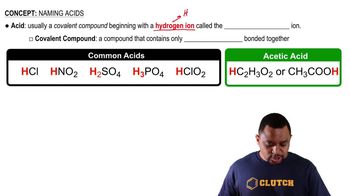
Covalent compound typically starting with hydrogen ion and containing only nonmetals, often with unique naming rules.
Track progress
Control buttons has been changed to "navigation" mode.
1/14
Related flashcards
Related practice
Recommended videos
Naming Acids quiz
Naming Acids
15 Terms
Naming Acids
3. Ionic Compounds
3 problems
Topic
Jules
Naming Ionic Hydrates
3. Ionic Compounds
1 problem
Topic
Jules
3. Ionic Compounds - Part 1 of 3
5 topics
10 problems
Chapter
Jules
3. Ionic Compounds - Part 2 of 3
7 topics
11 problems
Chapter
Jules
3. Ionic Compounds - Part 3 of 3
2 topics
4 problems
Chapter
Guided course
02:15
Naming Acids
10778
views
84
rank
Guided course
02:49
Naming Acids
8763
views
62
rank
Guided course
02:21
Naming Acids Example 1
8812
views
60
rank
Terms in this set (14)
Hide definitions
Acid
Covalent compound typically starting with hydrogen ion and containing only nonmetals, often with unique naming rules.
Hydrogen Ion
Positively charged particle (H+) that initiates the structure of most acids and is central to acid naming.
Hydronium Ion
Alternate name for the hydrogen ion, emphasizing its role in acid chemistry.
Covalent Compound
Substance formed by nonmetals sharing electrons, foundational to acid structure.
Nonmetal
Element type found in acids, especially as the partner to hydrogen in covalent bonding.
Binary Acid
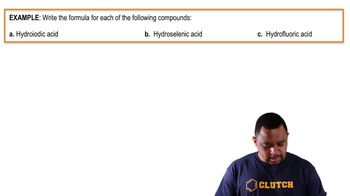
Acid composed of hydrogen and a single nonmetal anion, excluding oxygen, named with 'hydro-' and 'ic acid' endings.
Oxyacid
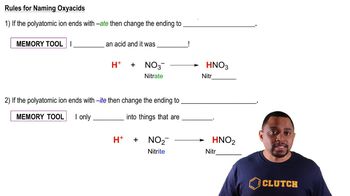
Acid containing hydrogen and a polyatomic ion with oxygen, named based on the ion's suffix.
Polyatomic Ion
Charged group of atoms, often containing oxygen, that combines with hydrogen to form oxyacids.
Anion
Negatively charged ion, typically a nonmetal, that pairs with hydrogen in acid formation.
Nomenclature
Systematic method for naming acids based on their composition and the endings of their components.
Base Name
Root portion of a nonmetal's name used in acid naming, sometimes modified for sulfur and phosphorus.
Suffix
Ending added to acid names, such as 'ic acid' or 'ous acid,' determined by the polyatomic ion present.
Exception
Case where standard acid naming rules do not apply, such as acetic acid's structure.
Periodic Table
Reference chart essential for identifying nonmetals, their charges, and forming correct acid names.
 BackBack
 02:15
02:15