Skip to main content
GOB Chemistry
My Course
Learn
Exam Prep
AI Tutor
Study Guides
Textbook Solutions
Flashcards
Explore
Try the app
My Course
Learn
Exam Prep
AI Tutor
Study Guides
Textbook Solutions
Flashcards
Explore
Try the app
Back
Naming Aldehydes definitions
You can tap to flip the card.
Aldehyde
You can tap to flip the card.
👆
Aldehyde
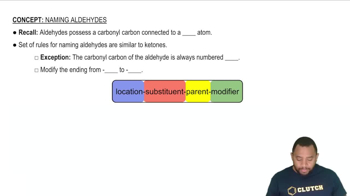
Organic compound featuring a carbonyl group bonded to a hydrogen atom, always at the end of a carbon chain.
Track progress
Control buttons has been changed to "navigation" mode.
1/14
Related flashcards
Related practice
Recommended videos
Naming Aldehydes quiz
Naming Aldehydes
15 Terms
Naming Aldehydes
15. Aldehydes and Ketones
6 problems
Topic
Jules
Tollens' and Benedict's Test
15. Aldehydes and Ketones
4 problems
Topic
Jules
15. Aldehydes and Ketones
5 topics
13 problems
Chapter
Jules
Guided course
2:02
Common Naming: Substituted Aldehydes Concept 3
3137
views
4
rank
Guided course
1:27
Common Naming: Simple Aldehydes Concept 2
3329
views
5
rank
Guided course
0:54
IUPAC Rules for Naming Aldehydes Concept 1
3139
views
2
rank
Terms in this set (14)
Hide definitions
Aldehyde
Organic compound featuring a carbonyl group bonded to a hydrogen atom, always at the end of a carbon chain.
Carbonyl Group
Functional group consisting of a carbon atom double-bonded to an oxygen atom, central to aldehyde structure.
Parent Chain
Longest continuous chain of carbon atoms containing the carbonyl group, used as the base for naming.
Prefix
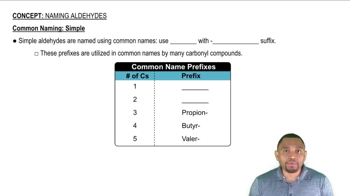
Short word part indicating the number of carbons in simple aldehydes, such as form, acet, propion, butyl, or valor.
Suffix
Word ending added to the parent chain name, changed from 'e' to 'al' for aldehydes.
Substituent
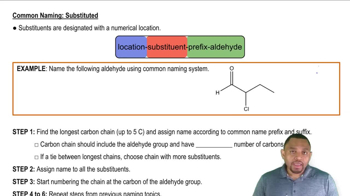
Atom or group attached to the main carbon chain, named and numbered based on its position from the carbonyl carbon.
Numerical Location
Number assigned to each carbon in the chain, starting from the carbonyl carbon, to indicate substituent positions.
Common Name
Traditional naming system for simple aldehydes using specific prefixes and the suffix 'aldehyde.'
Formaldehyde
Simplest aldehyde, containing only one carbon atom, commonly used as a preservative.
Acetaldehyde
Aldehyde with two carbon atoms, known for its role in metabolism and as a building block in chemistry.
Propionaldehyde
Aldehyde with three carbon atoms, named using the propion prefix in the common system.
Butyraldehyde
Aldehyde with four carbon atoms, named using the butyl prefix in the common system.
Valeraldehyde
Aldehyde with five carbon atoms, named using the valor prefix in the common system.
Chloro Group
Substituent consisting of a chlorine atom, named as 'chloro' and given a position number in the chain.
 BackBack
 2:02
2:02