Back

Naming Alkynes quiz

Control buttons has been changed to "navigation" mode.
1/15
  • What type of bond characterizes alkynes?

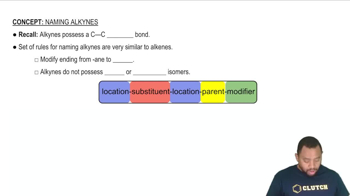
    Alkynes are characterized by a carbon-carbon triple bond.
  • How does the suffix change when naming alkynes compared to alkanes?

    The suffix changes from 'ane' in alkanes to 'yne' in alkynes.
  • Are cis or trans isomers possible in alkynes?

    No, alkynes do not have cis or trans isomers due to the nature of the triple bond.
  • What must be specified when naming an alkyne?

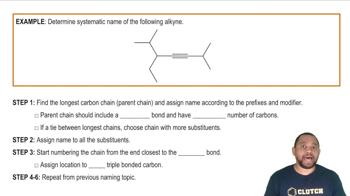
    The numerical location of the triple bond and any substituents must be specified.
  • What is the main similarity between naming alkynes and alkenes?

    Both require specifying the location of the multiple bond and substituents.
  • Why do alkynes not have cis or trans isomers?

    The triple bond restricts rotation, preventing cis or trans isomerism.
  • What is the modifier used in the name of an alkyne?

    The modifier is the suffix '-yne' indicating a triple bond.
  • When naming alkynes, what must be included besides the base name?

    The location of the triple bond and any substituents must be included.
  • What is the difference in suffix between alkanes and alkynes?

    Alkanes use '-ane' while alkynes use '-yne'.
  • What does the triple bond in alkynes affect in their naming?

    It requires specifying its position in the molecule's name.
  • How are substituents handled in alkyne nomenclature?

    Their numerical location is specified in the name.
  • What is the base rule for naming alkynes?

    Follow alkene naming rules but change the suffix to '-yne'.
  • What must be changed in the name when moving from an alkane to an alkyne?

    The ending changes from '-ane' to '-yne'.
  • Why is it important to specify the location of the triple bond in alkynes?

    It distinguishes different structural isomers of alkynes.
  • What is the key structural feature of alkynes?

    A carbon-carbon triple bond is the key feature.