Back

Naming Ionic Compounds quiz

Control buttons has been changed to "navigation" mode.
1/15
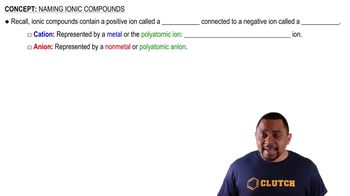
  • What are the two main components of an ionic compound?

    An ionic compound consists of a positive ion (cation) and a negative ion (anion).
  • How can you remember that a cation is positively charged?

    The 't' in cation looks like a plus sign, reminding you it is positive.
  • What are the two types of cations found in ionic compounds?

    Cations can be metals or the polyatomic ammonium ion (NH4+).
  • Which polyatomic ion is a common positive ion in ionic compounds?

    The ammonium ion (NH4+) is a common positive polyatomic ion.
  • What types of ions can anions be in ionic compounds?

    Anions can be nonmetals or polyatomic ions with negative charges.
  • When naming an ionic compound, which ion is written first?

    The cation is always written first, followed by the anion.
  • How do you name the cation if it is a metal with only one possible charge?

    You use the metal's name without a Roman numeral.
  • What do you add to the name of a metal cation if it has multiple possible charges?

    A Roman numeral is added to indicate the specific positive charge.
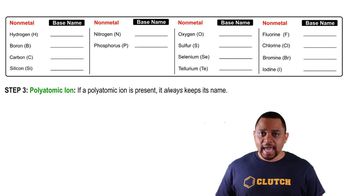
  • What is the base name of a nonmetal in an ionic compound?

    The base name is the beginning part of the nonmetal's name that remains unchanged.
  • How is the name of a nonmetal anion modified in an ionic compound?

    The ending of the nonmetal's name is changed to 'ide.'
  • What is the base name for the nonmetal oxygen?

    The base name for oxygen is 'ox.'
  • How are polyatomic ions named in ionic compounds?

    Polyatomic ions retain their full names in the compound.
  • Give an example of a polyatomic ion that keeps its name in an ionic compound.

    Phosphate remains 'phosphate' in the compound name.
  • Why don't main group metals usually need a Roman numeral in their names?

    Main group metals typically have only one possible charge.
  • What is the base name for the nonmetal chlorine?

    The base name for chlorine is 'chlor.'