Back

Nitrogenous Bases quiz

Control buttons has been changed to "navigation" mode.
1/15
  • What are the two categories of nitrogenous bases?

    The two categories are pyrimidines (single-ringed) and purines (double-ringed).
  • Which nitrogenous bases are classified as pyrimidines?

    Cytosine, thymine, and uracil are pyrimidines.
  • Which nitrogenous bases are classified as purines?

    Adenine and guanine are purines.
  • What is the memory tool for remembering pyrimidines?

    The memory tool is 'Creepy tombs under pyramids,' where 'Creepy' is cytosine, 'Tombs' is thymine, and 'Under' is uracil.
  • What is the memory tool for remembering purines?

    The memory tool is 'Pure as gold,' where 'Pure' stands for purines, 'As' for adenine, and 'Gold' for guanine.
  • Which pyrimidine is found only in DNA?

    Thymine is found only in DNA.
  • Which pyrimidine is found only in RNA?

    Uracil is found only in RNA.
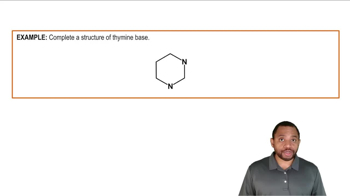
  • What is the basic structure of a pyrimidine?

    A pyrimidine has a single ring with two nitrogen atoms.
  • How does the structure of thymine differ from uracil?

    Thymine has an additional methyl group compared to uracil.
  • What functional group does cytosine have that uracil does not?

    Cytosine has an amine (NH2) group instead of one of the carbonyl groups found in uracil.
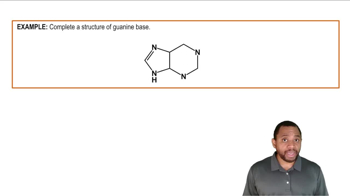
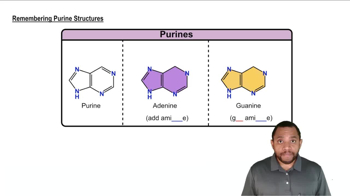
  • How many rings are present in a purine structure?

    Purines have two fused rings.
  • How many nitrogen atoms are embedded in the purine ring structure?

    There are four nitrogen atoms embedded in the purine rings.
  • What group is added to the purine base to form adenine?

    An amine (NH2) group is added to form adenine.
  • What groups are added to the purine base to form guanine?

    A carbonyl (oxygen) group and an amine (NH2) group are added to form guanine.
  • Why can't a carbon in a pyrimidine or purine ring make five bonds?

    Carbon can only make up to four bonds, so adding a double bond where a carbonyl is present would exceed this limit.