Skip to main content
GOB Chemistry
My Course
Learn
Exam Prep
AI Tutor
Study Guides
Textbook Solutions
Flashcards
Explore
Try the app
My Course
Learn
Exam Prep
AI Tutor
Study Guides
Textbook Solutions
Flashcards
Explore
Try the app
Back
Peptides quiz
You can tap to flip the card.
What type of reaction forms a peptide bond between amino acids?
You can tap to flip the card.
👆
What type of reaction forms a peptide bond between amino acids?
A condensation reaction forms a peptide bond, resulting in the loss of water.
Track progress
Control buttons has been changed to "navigation" mode.
1/15
Related flashcards
Related practice
Recommended videos
Peptides definitions
Peptides
15 Terms
Peptides
18. Amino Acids and Proteins
7 problems
Topic
Jules
Primary Protein Structure
18. Amino Acids and Proteins
6 problems
Topic
Jules
18. Amino Acids and Proteins - Part 1 of 2
6 topics
13 problems
Chapter
Jules
18. Amino Acids and Proteins - Part 2 of 2
5 topics
13 problems
Chapter
Jules
Guided course
1:18
Drawing & Naming Peptides Concept 2
3250
views
4
rank
Guided course
3:07
Peptides Concept 1
3298
views
5
rank
Guided course
1:24
Peptides Example 1
3250
views
4
rank
Terms in this set (15)
Hide definitions
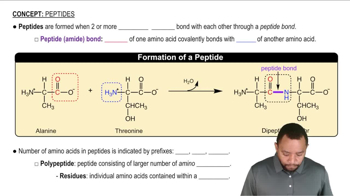
What type of reaction forms a peptide bond between amino acids?
A condensation reaction forms a peptide bond, resulting in the loss of water.
What groups are involved in forming a peptide bond?
The carboxyl group of one amino acid bonds with the amino group of another amino acid.
What is another name for a peptide bond?
A peptide bond is also known as an amide bond.
What is lost during the formation of a peptide bond?
One oxygen atom and two hydrogen atoms are lost, forming a molecule of water.
How is the structure of a peptide represented using amino acid codes?
It is shown by connecting the three-letter codes of the amino acids with a hyphen.
What does the prefix 'di-' in dipeptide indicate?
'Di-' indicates that the peptide contains two amino acids.
How many amino acids are in a tripeptide?
A tripeptide contains three amino acids.
What is a polypeptide?
A polypeptide is a peptide consisting of many amino acid residues.
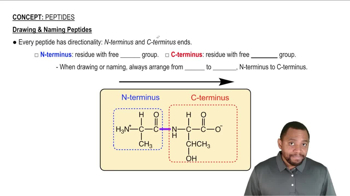
What is meant by the directionality of a peptide?
Directionality refers to the peptide running from the N terminus (free amino group) to the C terminus (free carboxyl group).
When drawing or naming peptides, which end is placed on the left?
The N terminus, which has the free amino group, is placed on the left.
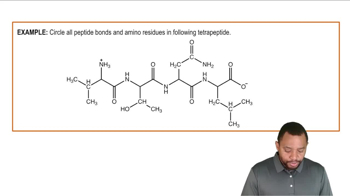
What is a residue in the context of peptides?
A residue is an individual amino acid within a peptide chain.
How is a peptide bond visually represented in a peptide structure?
It is represented by a hyphen between the three-letter codes of the amino acids.
What happens to the nitrogen atom in the amino group after peptide bond formation?
The nitrogen retains one hydrogen atom after the loss of two hydrogens during bond formation.
What is the C terminus of a peptide?
The C terminus is the end of the peptide with a free carboxyl group.
Why is it important to maintain directionality when naming or drawing peptides?
Maintaining directionality ensures the correct sequence and orientation from N terminus to C terminus.
 BackBack
 1:18
1:18