Back

Periodic Table: Classifications quiz

Control buttons has been changed to "navigation" mode.
1/15
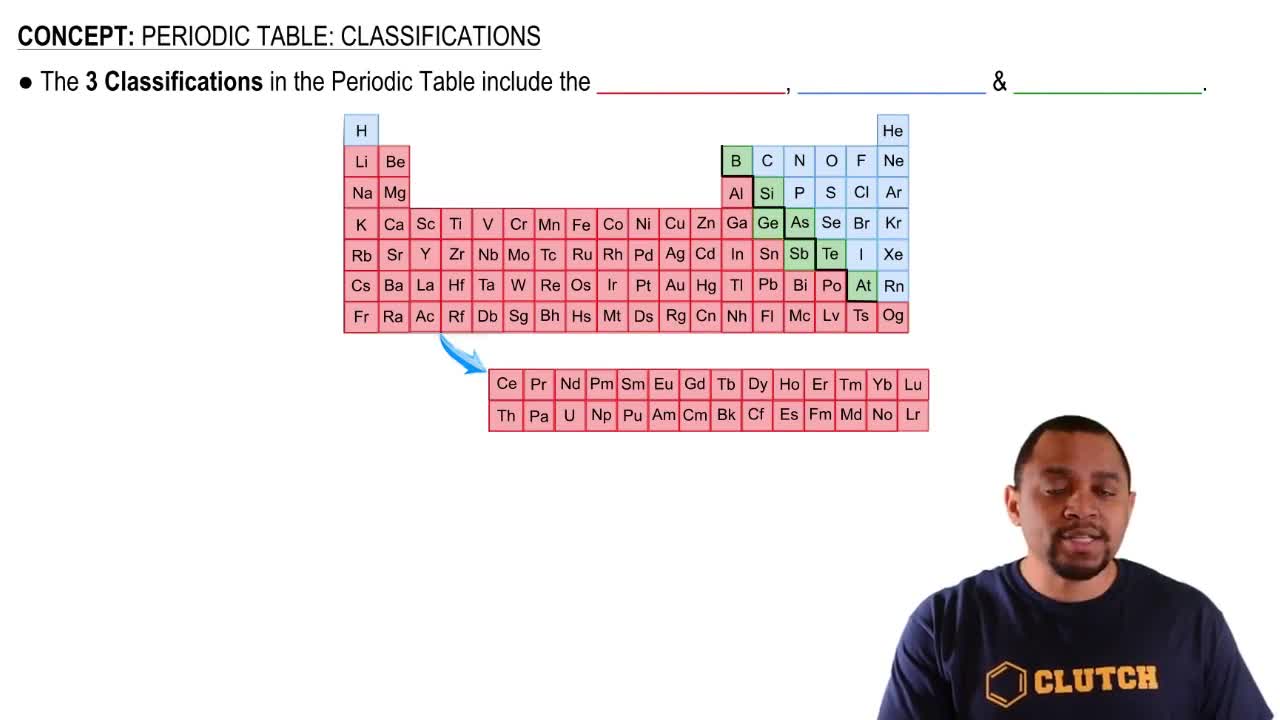
  • What are the three main classifications of elements on the periodic table?

    The three classifications are metals, nonmetals, and metalloids.
  • Which color represents metals on the periodic table in the lesson example?

    Metals are represented by the color red.
  • What physical property describes the shininess of metals?

    Luster describes the shininess of metals.
  • How do metals conduct electricity compared to nonmetals?

    Metals are good conductors of electricity, while nonmetals are poor conductors.
  • What does it mean for a metal to be malleable?

    Malleable means metals can be hammered into thin sheets without breaking.
  • Where are most nonmetals located on the periodic table?

    Most nonmetals are found on the far right side of the periodic table, except hydrogen.
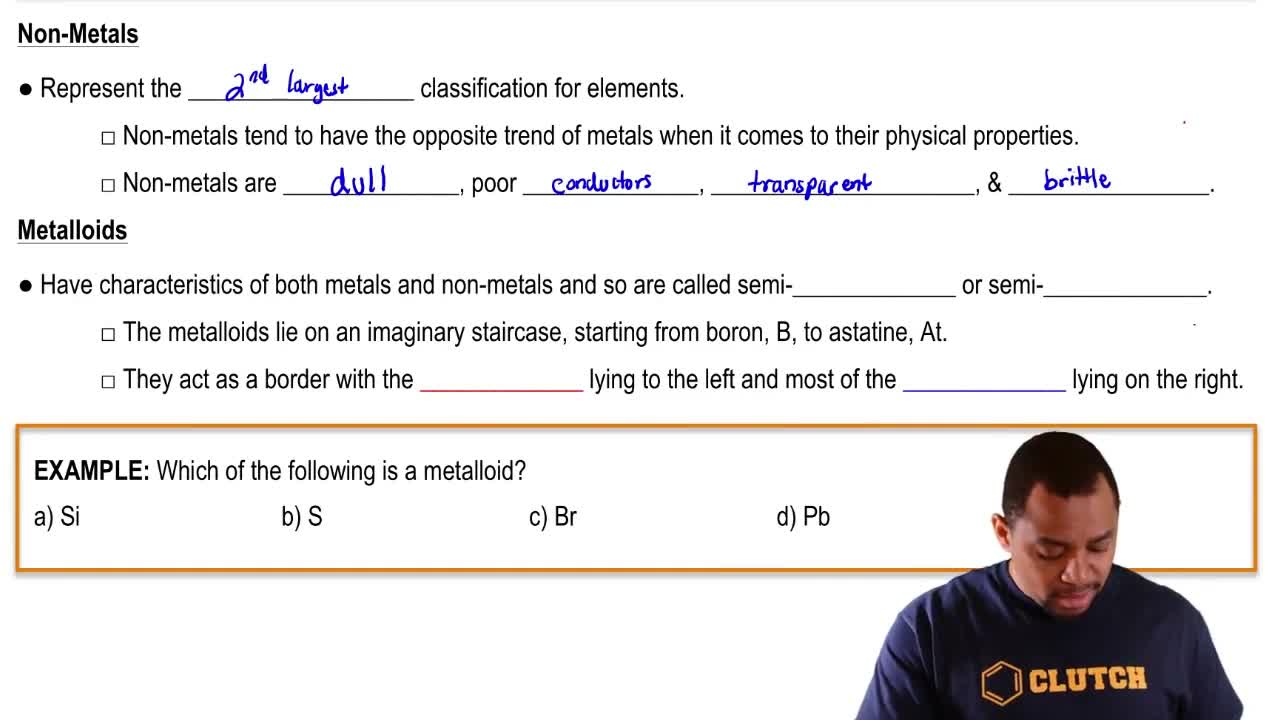
  • What is the opposite of luster in nonmetals?

    Nonmetals are dull, lacking the luster that metals have.
  • How do nonmetals respond to being hammered compared to metals?

    Nonmetals are brittle and will crumble when hammered, unlike malleable metals.
  • What is the imaginary staircase on the periodic table used to identify?

    The staircase helps locate the metalloids, which are elements with properties of both metals and nonmetals.
  • How many metalloids are there, and can you name two?

    There are seven metalloids; examples include boron and silicon.
  • What is a key technological use of silicon, a metalloid?

    Silicon is used in microchips and semiconductors, making it essential for computers and phones.
  • Why is Silicon Valley named 'Silicon Valley'?

    It is named after the silicon chips developed there, not the tech companies.
  • What are the two rows often omitted from the periodic table for visual clarity?

    The lanthanides and actinides are often shown below the main table but are part of it.
  • What physical property do metals have that nonmetals may lack regarding transparency?

    Metals are opaque, while some nonmetals can be transparent.
  • What term is used for metalloids because they have properties of both metals and nonmetals?

    Metalloids are also called semimetals or semiconductors.