Back

Periodic Trend: Ionic Radius (Simplified) quiz

Control buttons has been changed to "navigation" mode.
1/15
  • What is the definition of ionic radius?

    Ionic radius is the distance between an ion's nucleus and its outer shell.
  • Does the periodic table directly determine the trend for ionic radius?

    No, the periodic table does not directly determine the trend for ionic radius; it depends on the number of electrons in the ion.
  • How does the ionic radius change as the number of electrons in an ion increases?

    The ionic radius increases as the number of electrons in an ion increases.
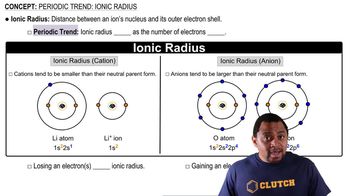
  • What happens to the ionic radius when an atom loses electrons to become a cation?

    The ionic radius decreases when an atom loses electrons to become a cation.
  • Are cations generally larger or smaller than their neutral parent atoms?

    Cations are generally smaller than their neutral parent atoms.
  • Why is a lithium ion (Li⁺) smaller than a neutral lithium atom?

    A lithium ion is smaller because it loses its outermost electron shell, reducing the number of electron shells.
  • What happens to the ionic radius when an atom gains electrons to become an anion?

    The ionic radius increases when an atom gains electrons to become an anion.
  • Are anions generally larger or smaller than their neutral parent atoms?

    Anions are generally larger than their neutral parent atoms.
  • Why does the oxide ion (O²⁻) have a larger ionic radius than a neutral oxygen atom?

    The oxide ion has more electrons in its outer shell, increasing its ionic radius.
  • What is the general trend for ionic radius when electrons are lost?

    Losing electrons causes a decrease in ionic radius.
  • What is the general trend for ionic radius when electrons are gained?

    Gaining electrons causes an increase in ionic radius.
  • When comparing ions, what should you focus on to determine their relative sizes?

    You should focus on the total number of electrons the ion has.
  • Does moving towards the top right of the periodic table help predict ionic radius trends?

    No, moving towards the top right of the periodic table does not help predict ionic radius trends.
  • What is the relationship between the number of electrons and the size of the ionic radius?

    More electrons result in a larger ionic radius.
  • Why is the neutral form of an element usually bigger than its cation form?

    The neutral form has more electrons and possibly more electron shells, making it larger than its cation form.