GOB Chemistry
My Course
Learn
Exam Prep
AI Tutor
Study Guides
Textbook Solutions
Flashcards
Explore
My Course
Learn
Exam Prep
AI Tutor
Study Guides
Textbook Solutions
Flashcards
Explore
Back
Polyatomic Ions quiz
You can tap to flip the card.
Define:
What is a polyatomic ion?
You can tap to flip the card.
👆
What is a polyatomic ion?
A polyatomic ion is a tightly bound group of different elements with an overall charge, either positive or negative.
Track progress
Control buttons has been changed to "navigation" mode.
1/15
Related flashcards
Related practice
Recommended videos
Polyatomic Ions definitions
Polyatomic Ions
15 Terms
Polyatomic Ions
3. Ionic Compounds
3 problems
Topic

Jules
Naming Ionic Compounds
3. Ionic Compounds
3 problems
Topic
Jules
3. Ionic Compounds - Part 1 of 2
5 topics
9 problems
Chapter
Jules
3. Ionic Compounds - Part 2 of 2
6 topics
9 problems
Chapter
Jules
Guided course
01:54
Polyatomic Ions
Jules
13386
views
153
rank
Guided course
01:39
Polyatomic Ions
Jules
10639
views
112
rank
Guided course
01:26
Polyatomic Ions
Jules
9532
views
94
rank
1
comments
Terms in this set (15)
Hide definitions
What is a polyatomic ion?
A polyatomic ion is a tightly bound group of different elements with an overall charge, either positive or negative.
What distinguishes polyatomic oxyanions from other polyatomic ions?
Polyatomic oxyanions are negatively charged ions that contain oxygen.
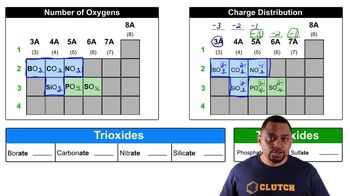
How many oxygens are in trioxides and what suffix do their names end with?
Trioxides have 3 oxygens and their names end with 'ate'.
Which elements commonly form trioxides and what are their formulas?
Borate (BO3^3-), carbonate (CO3^2-), nitrate (NO3^-), and silicate (SiO3^2-) are common trioxides.
How many oxygens are in tetraoxides and which elements commonly form them?
Tetraoxides have 4 oxygens and are commonly formed by phosphorus (PO4^3-) and sulfur (SO4^2-).
What are the typical charges for trioxides and tetraoxides based on periodic table patterns?
Trioxides typically have charges of -3, -2, and -1; tetraoxides have charges of -3 and -2.
What happens to the name and charge of a polyatomic ion when the number of oxygens is decreased by one?
The suffix changes from 'ate' to 'ite', but the charge remains the same.
What is the formula and charge for sulfite?
Sulfite is SO3^2-, with the same charge as sulfate but one less oxygen.
What are halogen oxyanions and how are they named?
Halogen oxyanions contain halogens and oxygen; their names use prefixes and suffixes based on the number of oxygens.
What charge do all halogen oxyanions possess?
All halogen oxyanions possess a -1 charge.
What prefix and suffix are used for halogen oxyanions with four oxygens?
The prefix 'per-' and the suffix '-ate' are used for halogen oxyanions with four oxygens.
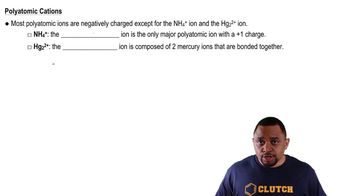
What are the two major positively charged polyatomic ions?
Ammonium (NH4^+) and mercury(I) ion (Hg2^2+) are the two major positively charged polyatomic ions.
Name three 'other' tetraoxides that must be memorized.
Permanganate (MnO4^-), chromate (CrO4^2-), and oxalate (C2O4^2-) are 'other' tetraoxides.
What is the formula for cyanide and how does it differ from cyanate?
Cyanide is CN^-, while cyanate is OCN^- (or CNO^-), with cyanate containing an oxygen.
What are two ways to write the formula for acetate ion?
Acetate can be written as C2H3O2^- or CH3COO^-.