Back

Polysaccharides quiz

Control buttons has been changed to "navigation" mode.
1/15
  • What are polysaccharides also known as?

    Polysaccharides are also known as glycans.
  • How many monosaccharide units can polysaccharides contain?

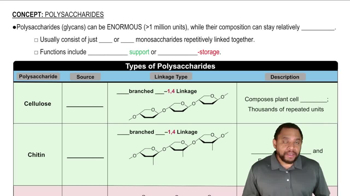
    Polysaccharides can contain over 1,000,000 monosaccharide units.
  • What are the two main functions of polysaccharides?

    Polysaccharides function as either structural support or energy storage.
  • Which polysaccharide forms plant cell walls?

    Cellulose forms plant cell walls.
  • What type of glycosidic linkage does cellulose have?

    Cellulose has beta 1-4 glycosidic linkages.
  • What is the main structural difference between cellulose and chitin?

    Chitin has an amide group at position 2 instead of the OH group found in cellulose.
  • Where is chitin commonly found?

    Chitin is found in arthropods, insects, and fungi.
  • What percentage of plant starch is made up by amylose?

    Amylose makes up about 20% of plant starch.
  • What type of glycosidic linkages does amylose have?

    Amylose has alpha 1-4 glycosidic linkages.
  • How does amylopectin differ from amylose in terms of structure?

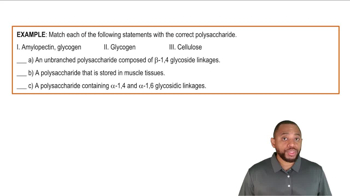
    Amylopectin is branched and contains both alpha 1-4 and alpha 1-6 glycosidic linkages, while amylose is unbranched.
  • What percentage of plant starch is amylopectin?

    Amylopectin makes up about 80% of plant starch.
  • Which polysaccharide is referred to as 'animal starch'?

    Glycogen is referred to as 'animal starch.'
  • How does glycogen's branching compare to amylopectin's?

    Glycogen has much more extensive branching than amylopectin.
  • Why do animals need more branching in glycogen than plants do in amylopectin?

    Animals need more branching in glycogen to quickly access energy due to their higher mobility.
  • Which polysaccharides are primarily involved in energy storage?

    Amylose, amylopectin, and glycogen are primarily involved in energy storage.