Skip to main content
GOB Chemistry
My Course
Learn
Exam Prep
AI Tutor
Study Guides
Textbook Solutions
Flashcards
Explore
Try the app
My Course
Learn
Exam Prep
AI Tutor
Study Guides
Textbook Solutions
Flashcards
Explore
Try the app
Back
Primary Protein Structure definitions
You can tap to flip the card.
Primary Structure
You can tap to flip the card.
👆
Primary Structure
Linear arrangement of amino acids in a protein, determined by the specific order of residues from N-terminus to C-terminus.
Track progress
Control buttons has been changed to "navigation" mode.
1/13
Related flashcards
Related practice
Recommended videos
Primary Protein Structure quiz
Primary Protein Structure
15 Terms
Primary Protein Structure
18. Amino Acids and Proteins
6 problems
Topic
Jules
Secondary Protein Structure
18. Amino Acids and Proteins
7 problems
Topic
Jules
18. Amino Acids and Proteins - Part 1 of 2
6 topics
13 problems
Chapter
Jules
18. Amino Acids and Proteins - Part 2 of 2
5 topics
13 problems
Chapter
Jules
Guided course
2:18
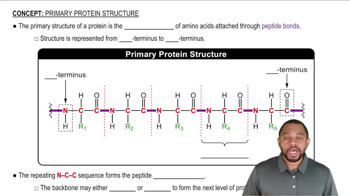
Primary Protein Structure Concept 1
1701
views
6
rank
Guided course
1:11
Primary Protein Structure Example 1
1632
views
4
rank
Terms in this set (13)
Hide definitions
Primary Structure
Linear arrangement of amino acids in a protein, determined by the specific order of residues from N-terminus to C-terminus.
Amino Acid
Building block of proteins, each containing an amino group, a carboxyl group, and a unique side chain.
Peptide Bond
Covalent linkage joining two amino acids, formed between the amino group of one and the carboxyl group of another.
N-Terminus
Starting end of a protein sequence, characterized by a free amino group.
C-Terminus
Ending end of a protein sequence, characterized by a free carbonyl group.
Residue
Individual amino acid unit within a protein chain, remaining after water is removed during bond formation.
Backbone
Repeating N-C-C sequence in a protein, forming the main structural framework of the chain.
Sequence
Specific order in which amino acids are arranged within a protein, determining its unique identity.
Protein
Macromolecule composed of one or more chains of amino acids, essential for biological structure and function.
Side Chain
Variable group attached to the central carbon of each amino acid, giving it distinct properties.
Carboxyl Group
Functional group present at the C-terminus, originally part of the terminal amino acid.
Amino Group
Functional group present at the N-terminus, marking the start of the protein chain.
Peptide
Short chain of amino acids linked by peptide bonds, forming part of a protein.
 BackBack
 2:18
2:18