What molecule is produced from glycolysis that enters pyruvate oxidation?
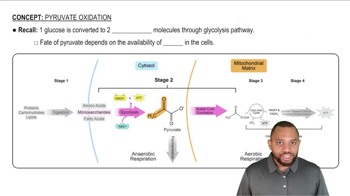
Pyruvate is produced from glycolysis and enters pyruvate oxidation.
Where in the cell does glycolysis occur?
Glycolysis occurs in the cytosol of the cell.
What determines the fate of pyruvate after glycolysis?
The availability of oxygen determines whether pyruvate undergoes fermentation or aerobic respiration.
What process does pyruvate undergo if oxygen is not available?
If oxygen is not available, pyruvate undergoes fermentation (anaerobic respiration).
Where is pyruvate transported for oxidation during aerobic respiration?
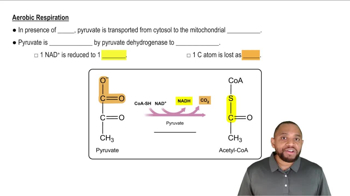
Pyruvate is transported to the mitochondrial matrix for oxidation during aerobic respiration.
What enzyme catalyzes the conversion of pyruvate to Acetyl CoA?
Pyruvate dehydrogenase catalyzes the conversion of pyruvate to Acetyl CoA.
What is reduced during the oxidation of pyruvate to Acetyl CoA?
NAD+ is reduced to NADH during the oxidation of pyruvate to Acetyl CoA.
What molecule is released as a waste product during pyruvate oxidation?
Carbon dioxide (CO2) is released as a waste product during pyruvate oxidation.
What is the main product of pyruvate oxidation that enters the Krebs cycle?
Acetyl CoA is the main product of pyruvate oxidation that enters the Krebs cycle.
What class of enzymes does pyruvate dehydrogenase belong to?
Pyruvate dehydrogenase belongs to the class of enzymes called dehydrogenases.
How many NADH molecules are produced per pyruvate during pyruvate oxidation?
One NADH molecule is produced per pyruvate during pyruvate oxidation.
What group is lost from pyruvate as CO2 during its oxidation?
The carboxyl group is lost from pyruvate as CO2 during its oxidation.
What is the role of coenzyme A in pyruvate oxidation?
Coenzyme A combines with the remaining two-carbon fragment from pyruvate to form Acetyl CoA.
What is the common metabolic pathway mentioned in the context of aerobic respiration?
The common metabolic pathway refers to the sequence of reactions including glycolysis, pyruvate oxidation, the Krebs cycle, and the electron transport chain under aerobic conditions.
Why can pyruvate oxidation only occur when oxygen is available?
Pyruvate oxidation requires oxygen because it is part of aerobic respiration, which depends on oxygen to proceed.
 Back
Back
 1:15
1:15