Back

Rate Law (Simplified) definitions

Control buttons has been changed to "navigation" mode.
1/13
  • Rate Law

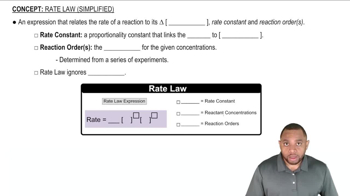
    An equation connecting reaction rate to reactant concentrations, rate constant, and reaction orders, focusing only on reactants.
  • Reaction Rate

    A measure of how quickly reactant concentrations change during a chemical process, typically expressed in molarity per unit time.
  • Reactant Concentration

    The amount of a substance present in a reaction mixture, usually indicated in molarity and enclosed in brackets.
  • Rate Constant

    A proportionality factor linking reaction rate to reactant concentrations, unique for each reaction and denoted by k.
  • Reaction Order

    The exponent applied to a reactant's concentration in the rate law, determined experimentally and indicating its effect on rate.
  • Exponent

    A mathematical value showing how many times a reactant's concentration is multiplied in the rate law expression.
  • Molarity

    A unit expressing the concentration of a solution, defined as moles of solute per liter of solution.
  • Chemical Equation

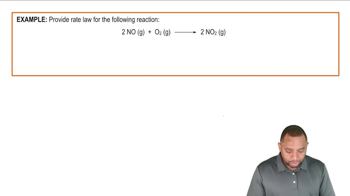
    A symbolic representation of a chemical reaction, showing reactants and products, but only reactants are used in rate law.
  • Product

    A substance formed from reactants in a chemical reaction, not included in the rate law expression.
  • Proportionality Constant

    A fixed value that relates two quantities, such as rate and concentration, in a mathematical relationship.
  • Balanced Equation

    A chemical equation with equal numbers of each atom on both sides, used to identify reactants for the rate law.
  • Kinetics

    The study of reaction rates and the factors influencing how quickly chemical processes occur.
  • Activation Energy

    The minimum energy required for reactants to transform into products, influencing reaction rate.