Back

Scientific Notation quiz

Control buttons has been changed to "navigation" mode.
1/15
  • What is the main purpose of using scientific notation?

    Scientific notation is used to simplify the representation of very large or very small numbers, making them more manageable.
  • What are the three main components of a number written in scientific notation?

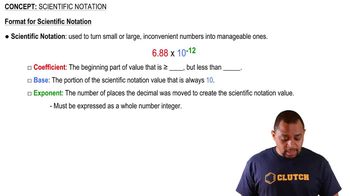
    The three main components are the coefficient, the base (which is always 10), and the exponent.
  • What is the required range for the coefficient in scientific notation?

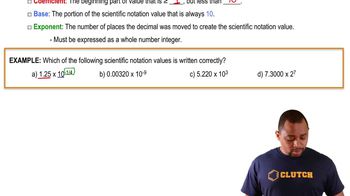
    The coefficient must be equal to or greater than 1 but less than 10.
  • What does the exponent in scientific notation indicate?

    The exponent shows how many places the decimal point was moved to create the scientific notation value.
  • What must the exponent in scientific notation always be?

    The exponent must always be a whole number integer, not a decimal or fraction.
  • How do you convert a number from scientific notation to standard notation if the exponent is positive?

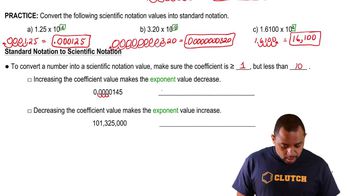
    Move the decimal point of the coefficient to the right by the number of places indicated by the exponent.
  • How do you convert a number from scientific notation to standard notation if the exponent is negative?

    Move the decimal point of the coefficient to the left by the number of places indicated by the exponent.
  • What effect does a positive exponent have on the coefficient in scientific notation?

    A positive exponent makes the coefficient value larger.
  • What effect does a negative exponent have on the coefficient in scientific notation?

    A negative exponent makes the coefficient value smaller.
  • When converting from standard notation to scientific notation, what must you ensure about the coefficient?

    You must adjust the decimal point so the coefficient is between 1 and 10.
  • What happens to the exponent when you increase the coefficient during conversion to scientific notation?

    Increasing the coefficient causes the exponent to decrease.
  • What happens to the exponent when you decrease the coefficient during conversion to scientific notation?

    Decreasing the coefficient causes the exponent to increase.
  • Why is scientific notation especially useful in chemistry?

    It helps manage extremely large or small numbers that are inconvenient to write in standard notation.
  • What is the base always equal to in scientific notation?

    The base is always 10 in scientific notation.
  • How do you determine whether to move the decimal point left or right when converting from scientific to standard notation?

    Move the decimal right if the exponent is positive and left if the exponent is negative.