Back

Significant Figures (Simplified) quiz

Control buttons has been changed to "navigation" mode.
1/15
  • What is the main difference between exact and inexact numbers?

    Exact numbers are obtained from counting or definitions and have no uncertainty, while inexact numbers come from measurements or calculations and contain some uncertainty.
  • Give an example of an exact number.

    An example of an exact number is 125 students in a lecture or 13 in a baker's dozen.
  • Give an example of an inexact number.

    An example of an inexact number is a textbook measured to be 12.53 inches.
  • What do significant figures represent?

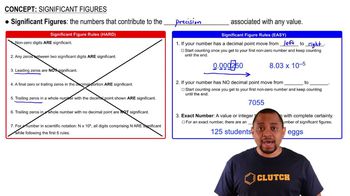
    Significant figures represent the precision of a value.
  • When a number has a decimal point, how do you count significant figures?

    Start counting from the first non-zero digit moving left to right and count all digits until the end.
  • How do you count significant figures in a number without a decimal point?

    Start counting from the first non-zero digit moving right to left and count all digits until the end.
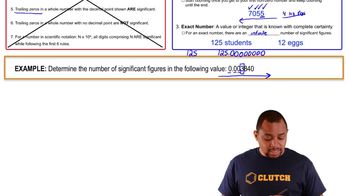
  • How many significant figures does 0.0025 have?

    It has 2 significant figures.
  • In scientific notation, which part of the number do you focus on for significant figures?

    You focus on the coefficient, not the base or exponent.
  • How many significant figures does 8.20 × 10^3 have?

    It has 3 significant figures.
  • What is the rule for significant figures in exact numbers?

    Exact numbers are considered to have an infinite number of significant figures.
  • Why do exact numbers have infinite significant figures?

    Because they are known with complete certainty and can be written with any number of trailing zeros without changing their value.
  • How many significant figures does 125.00 have?

    It has 5 significant figures.
  • If a number is 5000 with no decimal point, how many significant figures does it have?

    It has 1 significant figure.
  • What is the significance of trailing zeros in numbers with a decimal point?

    Trailing zeros after a decimal point are counted as significant figures.
  • Why is it important to consider significant figures when reporting measurements?

    Because significant figures reflect the precision of the measurement and help communicate the uncertainty in the value.