Back

Solubility and Intermolecular Forces quiz

Control buttons has been changed to "navigation" mode.
1/15
  • Why is it important to identify whether a compound is polar or non-polar?

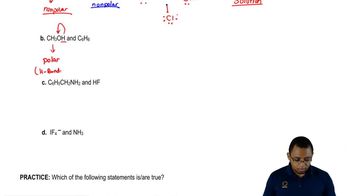
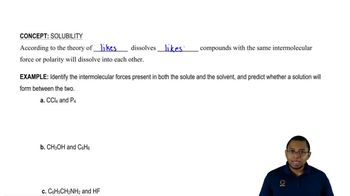
    Because compounds with similar polarities or intermolecular forces dissolve into each other to form solutions.
  • What does the phrase 'like dissolves like' mean in chemistry?

    It means that compounds with the same polarity or intermolecular forces will dissolve into each other.
  • Will two polar compounds mix together to form a solution?

    Yes, two polar compounds will mix well and form a solution.
  • What happens when a polar compound is mixed with a non-polar compound?

    They will not dissolve into each other due to their different polarities.
  • Can hydrogen bonding and dipole-dipole forces mix together? Why or why not?

    Yes, because both are polar intermolecular forces, so they can dissolve into each other.
  • Why won’t a compound with dipole-dipole forces mix with one with London dispersion forces?

    Because dipole-dipole is polar and London dispersion is non-polar, so their different polarities prevent mixing.
  • What are the two main types of mixtures?

    The two main types are homogeneous mixtures and heterogeneous mixtures.
  • What is a homogeneous mixture?

    A homogeneous mixture has a uniform composition and properties throughout.
  • What is a heterogeneous mixture?

    A heterogeneous mixture has a non-uniform composition and does not mix completely.
  • Why don’t oil and water mix?

    Oil is non-polar and water is polar, so their different polarities prevent them from mixing.
  • Are all solutions homogeneous mixtures?

    Yes, all solutions are homogeneous mixtures.
  • Are all homogeneous mixtures solutions?

    No, not all homogeneous mixtures are solutions.
  • What is required for two substances to form a solution?

    They must have similar intermolecular forces or polarities.
  • What is an example of a heterogeneous mixture given in the lesson?

    Oil and water is an example of a heterogeneous mixture.
  • What happens in a solution at the molecular level?

    Both substances dissolve into each other and mix uniformly.