Back

Solubility Rules quiz

Control buttons has been changed to "navigation" mode.
1/15
  • What does solubility refer to in chemistry?

    Solubility is the ability of a solute to dissolve in a solvent, forming a solution.
  • What happens to a soluble ionic compound when placed in water?

    A soluble ionic compound breaks up into its ions, which become surrounded by water molecules and are called aqueous ions.
  • What is the difference between soluble and insoluble compounds?

    Soluble compounds dissolve and break into ions in solution, while insoluble compounds do not dissolve and remain as solids.
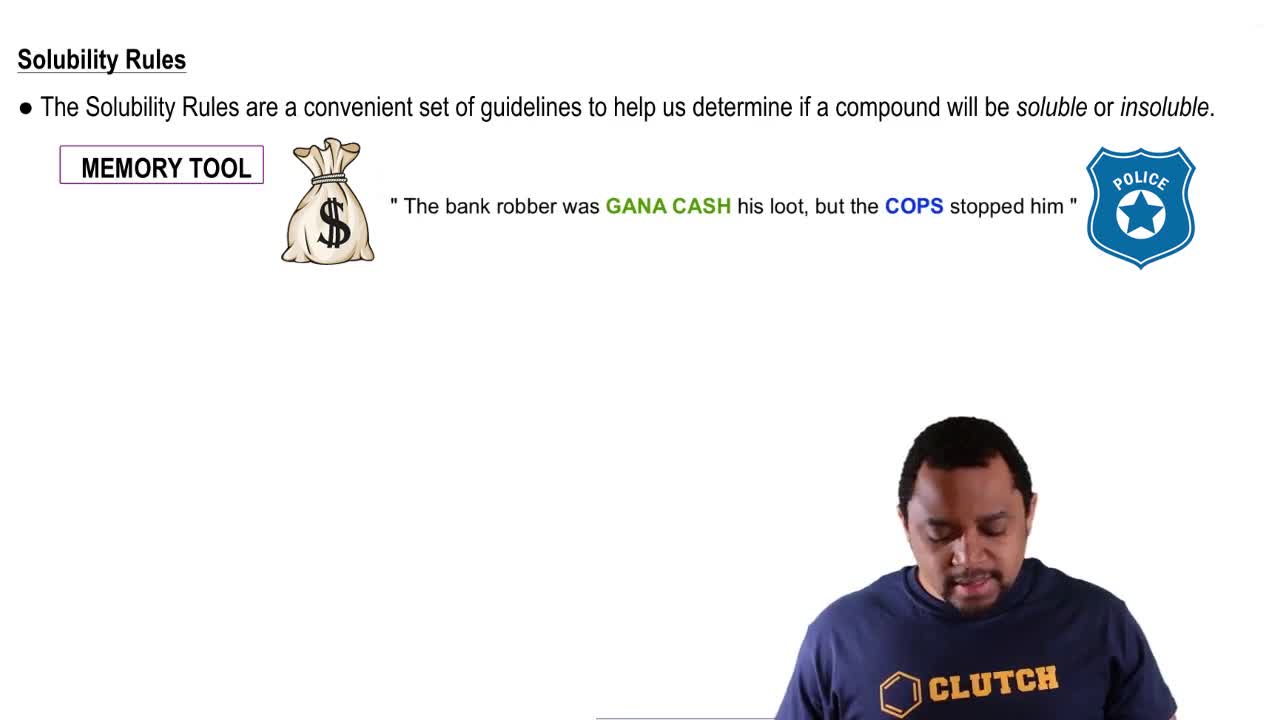
  • What mnemonic is used to remember the main solubility rules for soluble compounds?

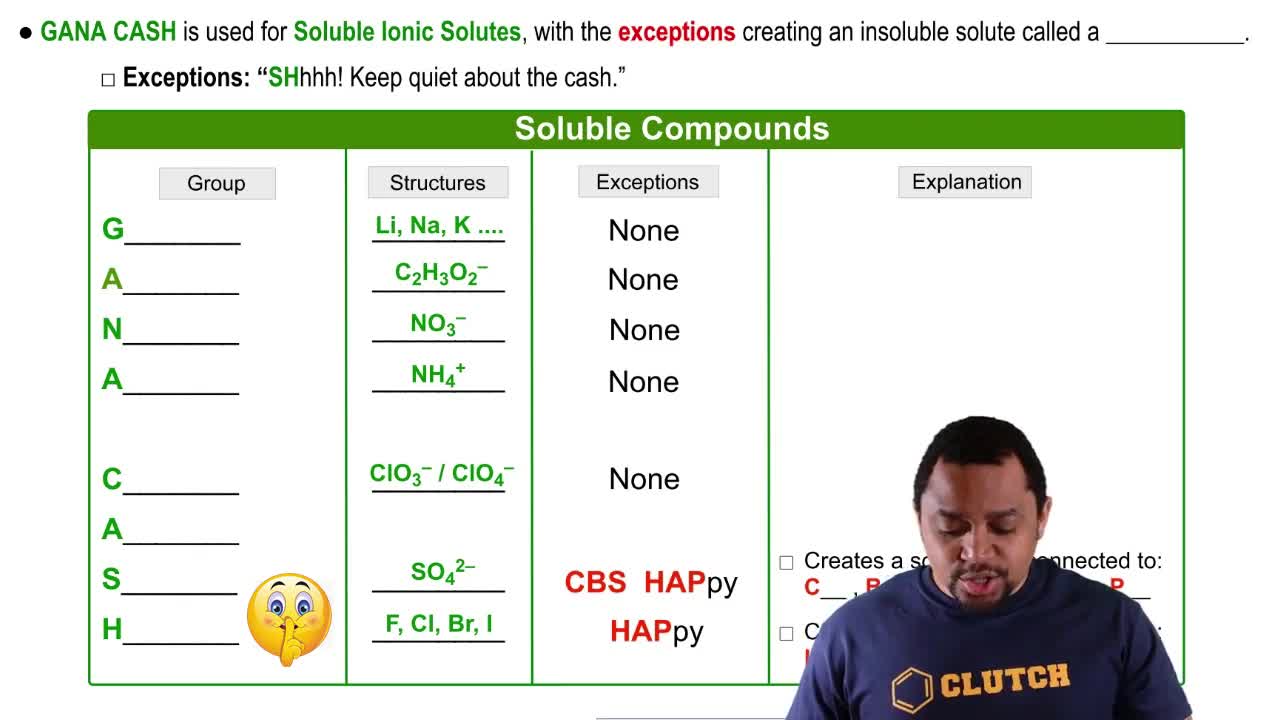
    The mnemonic 'Ghana Cash' is used to remember the main solubility rules for soluble compounds.
  • Which ions and compounds are always soluble according to 'Ghana Cash'?

    Group 1A elements, acetate, nitrate, ammonium, chlorate, and perchlorate are always soluble with no exceptions.
  • What are the exceptions to the solubility of sulfate ions?

    Sulfate ions are insoluble when combined with CBS (calcium, barium, strontium) or HAPI (mercury, silver, lead), forming a precipitate.
  • What are the exceptions to the solubility of halogens?

    Halogens are insoluble when combined with HAP (mercury, silver, lead), forming a precipitate.
  • What does the mnemonic 'COPS' help you remember?

    'COPS' helps you remember typically insoluble compounds: carbonate, chromate, phosphate, and sulfide.
  • Which ions are represented by the 'C' in 'COPS'?

    'C' stands for carbonate and chromate ions, which are generally insoluble.
  • What are the exceptions for oxides and hydroxides in the 'COPS' rule?

    Oxides and hydroxides become soluble when combined with calcium, barium, or strontium.
  • Which ions are represented by the 'P' and 'S' in 'COPS'?

    'P' stands for phosphate and 'S' stands for sulfide, both of which are generally insoluble except for specific exceptions.
  • When do sulfides become soluble according to the solubility rules?

    Sulfides become soluble when combined with calcium, barium, or strontium.
  • What is a precipitate in the context of solubility rules?

    A precipitate is an insoluble solid that forms when certain ions combine in solution and do not dissolve.
  • How do you determine the overall solubility of a compound?

    You determine solubility by applying both the 'Ghana Cash' and 'COPS' rules, including their exceptions.
  • What happens if a compound breaks an exception in the 'Ghana Cash' rule?

    If a compound breaks an exception in 'Ghana Cash,' it forms a precipitate and is considered insoluble.