GOB Chemistry
My Course
Learn
Exam Prep
AI Tutor
Study Guides
Textbook Solutions
Flashcards
Explore
My Course
Learn
Exam Prep
AI Tutor
Study Guides
Textbook Solutions
Flashcards
Explore
Back
Solubility: Temperature Effect quiz
You can tap to flip the card.
Define:
What is another name for solubility in chemistry?
You can tap to flip the card.
👆
What is another name for solubility in chemistry?
Solubility is also called concentration or molarity.
Track progress
Control buttons has been changed to "navigation" mode.
1/15
Related flashcards
Related practice
Recommended videos
Solubility: Temperature Effect definitions
Solubility: Temperature Effect
14 Terms
Solubility: Temperature Effect
9. Solutions
4 problems
Topic

Jules
Intro to Henry's Law
9. Solutions
2 problems
Topic
Jules
9. Solutions - Part 1 of 3
5 topics
12 problems
Chapter
Jules
9. Solutions - Part 2 of 3
7 topics
11 problems
Chapter
Jules
9. Solutions - Part 3 of 3
7 topics
11 problems
Chapter
Jules
Guided course
04:38
Solubility: Temperature Effect Concept 1
Jules
2629
views
8
rank
Guided course
01:29
Solubility: Temperature Effect Example 1
Jules
2359
views
5
rank
Terms in this set (15)
Hide definitions
What is another name for solubility in chemistry?
Solubility is also called concentration or molarity.
How is molarity defined?
Molarity is the number of moles of solute per liter of solution.
What happens when you add more solute than the solvent can dissolve?
The excess solute remains undissolved as a solid at the bottom of the container.
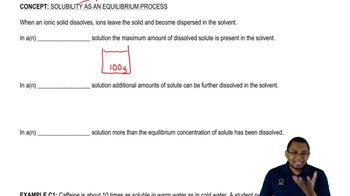
What term describes a solution that contains the maximum amount of dissolved solute?
This is called a saturated solution.
What is an unsaturated solution?
An unsaturated solution can still dissolve more solute; it has not reached its maximum capacity.
What is a supersaturated solution?
A supersaturated solution contains more solute than the equilibrium concentration, achieved by applying heat.
How can you create a supersaturated solution?
You can create a supersaturated solution by applying heat to dissolve more solute than the normal maximum.
What happens to a supersaturated solution when it cools?
The excess solute precipitates out and forms a solid at the bottom.
What is the relationship between solubility, concentration, and molarity?
They all refer to the amount of solute dissolved in a solvent and are essentially the same concept.
What is the effect of heat on solubility?
Heat increases solubility, allowing more solute to dissolve and creating a supersaturated solution.
What happens to the extra solute in a supersaturated solution when heat is removed?
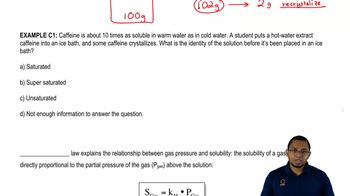
The extra solute recrystallizes and forms a precipitate at the bottom.
What does it mean if a solution is saturated?
It means the solvent has dissolved the maximum amount of solute possible.
How can you tell if a solution is unsaturated?
If more solute can still dissolve in the solvent, the solution is unsaturated.
What is the stability of a supersaturated solution?
Supersaturated solutions are unstable and will precipitate excess solute when cooled.
What is the result of adding 102 grams of solute to a solvent that can only dissolve 100 grams?
100 grams will dissolve, and the remaining 2 grams will stay as undissolved solid unless heat is applied to create a supersaturated solution.