Back

Solution Stoichiometry quiz

Control buttons has been changed to "navigation" mode.
1/15
  • What two new variables are included in solution stoichiometry compared to traditional stoichiometry?

    Solution stoichiometry includes volume and molarity as new variables.
  • How do you convert milliliters of a solution to liters?

    Divide the number of milliliters by 1000 to get liters.
  • What formula is used to calculate moles from volume and molarity?

    Moles = liters × molarity.
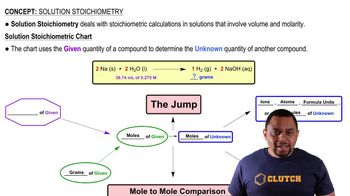
  • In the stoichiometric chart, what does the 'given' side represent?

    The 'given' side represents the information provided, such as grams, moles, volume, or molarity.
  • What is the purpose of the stoichiometric chart in solution stoichiometry?

    It helps determine the unknown quantity of a compound using the given quantity of another compound.
  • What does the word 'of' between two numbers indicate in solution stoichiometry?

    'Of' means to multiply the two numbers together.
  • What is the balanced chemical equation used in the example for solution stoichiometry?

    2 Na(s) + 2 H2O(l) → 1 H2(g) + 2 NaOH(aq).
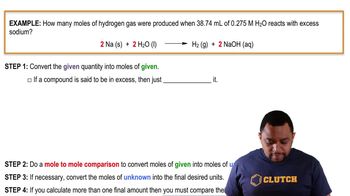
  • How do you find the moles of water given its volume and molarity?

    Convert the volume to liters and multiply by the molarity to get moles.
  • What is the next step after finding moles of the given compound in solution stoichiometry?

    Use a mole-to-mole comparison with the balanced equation to find moles of the unknown compound.
  • How do you convert moles of hydrogen gas to grams in solution stoichiometry?

    Multiply the moles of hydrogen gas by its molar mass to get grams.
  • Why is understanding traditional stoichiometry important for solution stoichiometry?

    It helps you understand the adaptations needed for calculations involving volume and molarity.
  • What is the 'jump' in the stoichiometric chart?

    The 'jump' is the step where you use a mole-to-mole comparison to move from the given to the unknown compound.
  • What information is typically given in solution stoichiometry problems?

    Problems often provide volume and molarity of a solution.
  • What are possible final units for the unknown in solution stoichiometry calculations?

    Final units can be grams, ions, atoms, formula units, or molecules.
  • What should you do if you are unfamiliar with traditional stoichiometry before learning solution stoichiometry?

    Review videos or materials on traditional stoichiometry to build a foundation.