Skip to main content
GOB Chemistry
My Course
Learn
Exam Prep
AI Tutor
Study Guides
Textbook Solutions
Flashcards
Explore
Try the app
My Course
Learn
Exam Prep
AI Tutor
Study Guides
Textbook Solutions
Flashcards
Explore
Try the app
Back
Steroids quiz
You can tap to flip the card.
What is the basic structure of the steroid nucleus?
You can tap to flip the card.
👆
What is the basic structure of the steroid nucleus?
The steroid nucleus consists of 3 cyclohexane rings and 1 cyclopentane ring fused together.
Track progress
Control buttons has been changed to "navigation" mode.
1/15
Related flashcards
Related practice
Recommended videos
Steroids definitions
Steroids
15 Terms
Steroids
23. Lipids
3 problems
Topic
Nicole
Cell Membranes
23. Lipids
3 problems
Topic
Nicole
23. Lipids - Part 1 of 3
6 topics
13 problems
Chapter
Ernest
23. Lipids - Part 2 of 3
6 topics
12 problems
Chapter
Nicole
23. Lipids - Part 3 of 3
1 topic
3 problems
Chapter
Guided course
1:34
Steroids Concept 2
3047
views
1
rank
Guided course
1:48
Steroids Example 3
2938
views
Guided course
3:52
Steroids Concept 4
3070
views
Terms in this set (15)
Hide definitions
What is the basic structure of the steroid nucleus?
The steroid nucleus consists of 3 cyclohexane rings and 1 cyclopentane ring fused together.
How are the rings in the steroid nucleus labeled and numbered?
The rings are labeled A, B, C, and D in alphabetical order, and the carbons are numbered from 1 to 17.
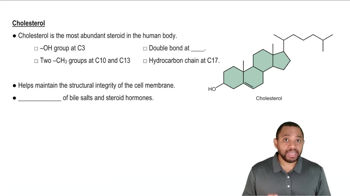
What is the most abundant steroid in the human body?
Cholesterol is the most abundant steroid in the human body.
Where is the hydroxyl (OH) group located on the cholesterol molecule?
The hydroxyl group is located at carbon number 3 on the cholesterol molecule.
What is the function of cholesterol in cell membranes?
Cholesterol helps maintain the structural integrity and rigidity of cell membranes.
What are bile acids synthesized from and where are they stored?
Bile acids are synthesized from cholesterol in the liver and stored in the gallbladder.
What is the main function of bile acids in the digestive system?
Bile acids emulsify lipids in the small intestine, increasing their surface area for digestion.
Why are bile acids also called bile salts?
They are called bile salts because they exist as anions (carboxylate ions) at intestinal pH.
What is the significance of bile acids in cholesterol absorption?
Bile acids help in the absorption of cholesterol in the small intestine.
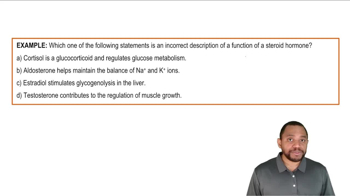
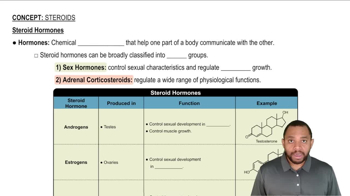
What are the two main groups of steroid hormones?
Steroid hormones are classified into sex hormones and adrenocorticosteroids.
Where are androgens produced and what is their main function?
Androgens are produced in the testes and regulate male sexual development and muscle growth.
What is the primary estrogen and where is it produced?
Estradiol is the primary estrogen, produced in the ovaries.
What is the main function of progestins and give an example?
Progestins control the menstrual cycle and pregnancy in females; an example is progesterone.
What do glucocorticoids regulate and where are they produced?
Glucocorticoids are produced in the adrenal glands and regulate glucose metabolism and inflammation.
What is the role of mineralocorticoids and provide an example?
Mineralocorticoids regulate sodium and potassium balance in the body; aldosterone is a key example.
 BackBack

 1:34
1:34