Skip to main content
GOB Chemistry
My Course
Learn
Exam Prep
AI Tutor
Study Guides
Textbook Solutions
Flashcards
Explore
Try the app
My Course
Learn
Exam Prep
AI Tutor
Study Guides
Textbook Solutions
Flashcards
Explore
Try the app
Back
Stoichiometry quiz
You can tap to flip the card.
What is the first step before performing any stoichiometric calculation?
You can tap to flip the card.
👆
What is the first step before performing any stoichiometric calculation?
The first step is to balance the chemical equation.
Track progress
Control buttons has been changed to "navigation" mode.
1/15
Related flashcards
Related practice
Recommended videos
Stoichiometry definitions
Stoichiometry
15 Terms
Stoichiometry
6. Chemical Reactions & Quantities
6 problems
Topic
Jules
Limiting Reagent
6. Chemical Reactions & Quantities
5 problems
Topic
Jules
6. Chemical Reactions & Quantities - Part 1 of 2
6 topics
9 problems
Chapter
Jules
6. Chemical Reactions & Quantities - Part 2 of 2
3 topics
8 problems
Chapter
Jules
Guided course
01:16
Stoichiometry
16964
views
212
rank
Guided course
03:04
Stoichiometry
13805
views
165
rank
Guided course
05:53
Stoichiometry Example 1
6528
views
73
rank
Terms in this set (15)
Hide definitions
What is the first step before performing any stoichiometric calculation?
The first step is to balance the chemical equation.
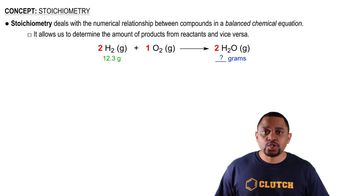
What does stoichiometry allow us to determine in a chemical reaction?
Stoichiometry allows us to determine the amount of products from reactants and vice versa.
Why is a balanced chemical equation essential for stoichiometry?
A balanced equation is essential because it provides the correct mole-to-mole ratios needed for calculations.
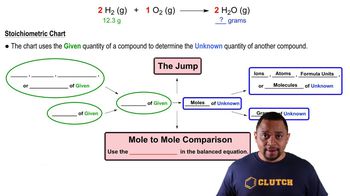
What is the purpose of the stoichiometric chart?
The stoichiometric chart helps convert given information about a compound into moles and then to the unknown quantity of another compound.
What is the 'given information' in a stoichiometric problem?
The given information is the quantity of a compound provided in the problem, such as grams, ions, atoms, or molecules.
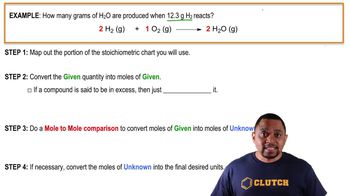
What is the first conversion step if the given information is in grams?
The first step is to convert grams of the given compound to moles of the given compound.
What is the 'jump' or 'leap of faith' in stoichiometry?
The 'jump' refers to converting from moles of the given compound to moles of the unknown compound using the balanced equation.
How do you perform a mole-to-mole comparison in stoichiometry?
You use the coefficients from the balanced chemical equation to compare moles of the given and unknown compounds.
After finding moles of the unknown, what can you convert to next?
You can convert moles of the unknown to grams, ions, atoms, formula units, or molecules of the unknown.
In the example provided, what is the given compound and its quantity?
The given compound is H2, and its quantity is 12.3 grams.
What is the unknown compound in the example, and what are you asked to find?
The unknown compound is H2O, and you are asked to find the grams of H2O produced.
Why must you always start with a balanced equation in stoichiometry?
Because the coefficients in the balanced equation are needed for accurate mole-to-mole conversions.
What are the possible units for the given information in a stoichiometric problem?
The given information can be in grams, ions, atoms, formula units, or molecules.
What is the general path for solving a stoichiometric problem starting with grams of a reactant?
The path is: grams of given → moles of given → moles of unknown → grams of unknown.
How does the stoichiometric chart help in solving stoichiometry questions?
It visually guides you through the necessary conversions from the given information to the unknown quantity.
 BackBack
 01:16
01:16