Back

Subatomic Particles (Simplified) quiz

Control buttons has been changed to "navigation" mode.
1/15
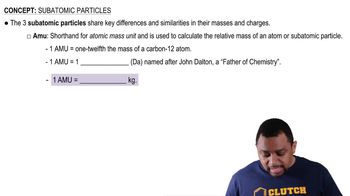
  • What does AMU stand for and what is its purpose?

    AMU stands for atomic mass unit and is used to calculate the relative mass of atoms or subatomic particles.
  • How is 1 AMU defined in terms of a carbon atom?

    1 AMU is defined as 1/12 the mass of a carbon atom.
  • What is the equivalent of 1 AMU in kilograms?

    1 AMU is equal to 1.66 x 10^-27 kilograms.
  • What is another name for 1 AMU and who is it named after?

    1 AMU is also called 1 Dalton (DA), named after John Dalton.
  • What are the three subatomic particles found in an atom?

    The three subatomic particles are neutrons, protons, and electrons.
  • Which subatomic particle is the heaviest?

    The neutron is the heaviest subatomic particle.
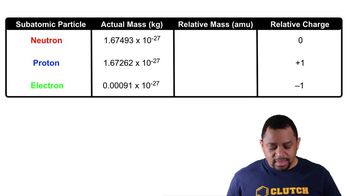
  • What is the actual mass of a neutron in kilograms?

    The actual mass of a neutron is 1.67493 x 10^-27 kilograms.
  • What is the actual mass of a proton in kilograms?

    The actual mass of a proton is 1.67262 x 10^-27 kilograms.
  • What is the actual mass of an electron in kilograms?

    The actual mass of an electron is 0.00091 x 10^-27 kilograms.
  • Where is most of the mass of an atom located?

    Most of the mass of an atom is located in the nucleus.
  • What is the relative mass of a neutron in AMU?

    The relative mass of a neutron is 1.00866 AMU.
  • What is the relative mass of a proton in AMU?

    The relative mass of a proton is 1.00727 AMU.
  • What is the relative mass of an electron in AMU?

    The relative mass of an electron is 0.00055 AMU.
  • What are the charges of neutrons, protons, and electrons?

    Neutrons are neutral (0), protons are positive (+1), and electrons are negative (-1).
  • Which subatomic particles are found in the nucleus?

    Protons and neutrons are found in the nucleus.