Back

Tertiary Protein Structure quiz

Control buttons has been changed to "navigation" mode.
1/15
  • What is the tertiary structure of a protein?

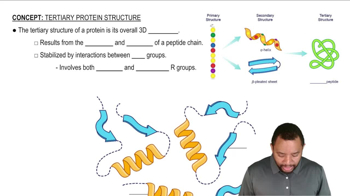
    It is the overall 3D shape of a protein, resulting from the twisting and bending of a peptide chain stabilized by interactions between R groups.
  • Which types of secondary structure elements are included in the tertiary structure?

    Alpha helices and beta pleated sheets are included in the tertiary structure.
  • Does the formation of tertiary structure alter the primary and secondary structures?

    No, tertiary structure builds upon primary and secondary structures without changing them.
  • What types of interactions stabilize the tertiary structure?

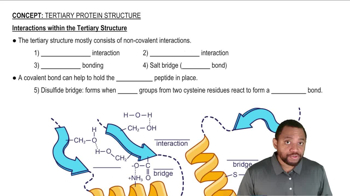
    Hydrophobic interactions, hydrophilic interactions, hydrogen bonding, salt bridges (ionic bonds), and disulfide bridges (covalent bonds) stabilize the tertiary structure.
  • What are hydrophobic interactions in tertiary structure?

    Hydrophobic interactions occur between nonpolar R groups that are afraid of water.
  • What are hydrophilic interactions in tertiary structure?

    Hydrophilic interactions involve polar R groups, such as those with OH groups, that interact favorably with water.
  • How do hydrogen bonds form in tertiary structure?

    Hydrogen bonds form between R groups that contain OH groups.
  • What is a salt bridge in protein tertiary structure?

    A salt bridge is an ionic bond formed between oppositely charged R groups.
  • What is a disulfide bridge?

    A disulfide bridge is a covalent bond formed between the sulfur atoms of two cysteine residues.
  • How does a disulfide bridge stabilize protein structure?

    It connects different elements like alpha helices and beta pleated sheets, ratcheting and holding the folded peptide in place.
  • Are most interactions in tertiary structure covalent or non-covalent?

    Most interactions are non-covalent, except for the disulfide bridge which is covalent.
  • What is the role of the tertiary structure in protein functionality?

    The tertiary structure brings the protein closer to being fully functional by further folding the polypeptide chain.
  • Can a polypeptide chain have multiple alpha helices and beta pleated sheets?

    Yes, a polypeptide chain can have multiple regions of alpha helices and beta pleated sheets.
  • What happens to the hydrogens in cysteine residues when forming a disulfide bridge?

    The hydrogens are lost, leaving behind a strong S-S bond between the cysteine residues.
  • What is the sequence of protein structure development leading to tertiary structure?

    The sequence is primary structure (amino acid chain), secondary structure (alpha helices and beta sheets), and then tertiary structure (folded 3D shape).