Back

The Colligative Properties definitions

Control buttons has been changed to "navigation" mode.
1/15
  • Colligative Properties

    Physical changes in a solvent caused by adding a solute, affecting boiling point, freezing point, vapor pressure, and osmotic pressure.
  • Boiling Point

    Temperature where liquid and gas phases are in equilibrium, increasing as more solute is added to a solvent.
  • Freezing Point

    Temperature where solid and liquid phases are in equilibrium, decreasing with the addition of solute.
  • Vapor Pressure

    Pressure exerted by a gas at the surface of a liquid, which decreases as solute is added.
  • Osmotic Pressure

    Force driving water movement from low to high solute concentration, increasing with more solute.
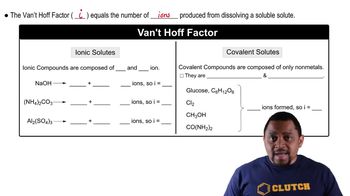
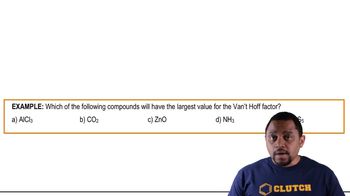
  • Van't Hoff Factor

    Number of ions produced when a soluble solute dissolves, used to quantify colligative effects.
  • Ionic Compound

    Substance composed of positive and negative ions, dissociating into multiple ions in solution.
  • Covalent Compound

    Substance made only of nonmetals, remaining intact in solution and not forming ions.
  • Non-electrolyte

    Substance that does not dissociate into ions in solution, typically a covalent compound.
  • Non-volatile

    Characteristic of a substance that does not readily vaporize or break into ions in solution.
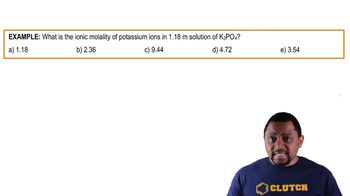
  • Molarity

    Concentration measure representing moles of solute per liter of solution.
  • Molality

    Concentration measure representing moles of solute per kilogram of solvent.
  • Osmolarity

    Product of van't Hoff factor and molarity, indicating total solute particles in solution.
  • Osmolality

    Product of van't Hoff factor and molality, reflecting total solute particles per kilogram of solvent.
  • Solution

    Homogeneous mixture formed when a solute is dissolved in a solvent.