What happens to the boiling point and osmotic pressure of a solvent when a solute is added?
Both the boiling point and osmotic pressure increase as more solute is added to a solvent.
How do freezing point and vapor pressure change when a solute is added to a pure solvent?
The freezing point and vapor pressure decrease as more solute is added to a pure solvent.
What is the boiling point in terms of phase equilibrium?
The boiling point is the temperature at which the liquid and gas phases of a substance are at equilibrium.
Define freezing point in the context of phase changes.
The freezing point is the temperature at which the solid and liquid phases of a substance are at equilibrium.
What is vapor pressure?
Vapor pressure is the pressure exerted by a gas at the surface of a liquid when the system is at equilibrium.
What does osmotic pressure drive?
Osmotic pressure drives the movement of water from an area of low solute concentration to an area of high solute concentration.
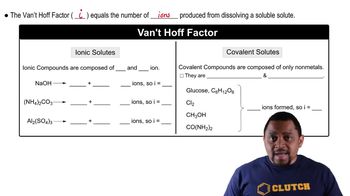
What is the van't Hoff factor (I)?
The van't Hoff factor (I) is the number of ions produced when a soluble solute dissolves in a solvent.
How do you determine the van't Hoff factor for ionic compounds?
For ionic compounds, the van't Hoff factor equals the total number of ions the compound dissociates into when dissolved.
What is the van't Hoff factor for covalent compounds?
The van't Hoff factor for covalent compounds is always 1 because they do not dissociate into ions.
What types of elements make up ionic compounds?
Ionic compounds are made up of positive ions (metals or ammonium) and negative ions (nonmetals).
What are the characteristics of covalent compounds in terms of volatility and ionization?
Covalent compounds are non-volatile and non-ionizable, meaning they do not break up into ions in solution.
How does the amount of solute added affect colligative properties?
The more solute added, the greater the effect on colligative properties such as boiling point, freezing point, vapor pressure, and osmotic pressure.
How is the total amount of solute in a solution calculated for colligative properties?
It is calculated by multiplying the van't Hoff factor (I) by the concentration of the solute, using either molarity or molality.
What is osmolarity and how is it calculated?
Osmolarity is the product of the van't Hoff factor (I) and the molarity of the compound, representing the total concentration of solute particles.
What is osmolality and how is it calculated?
Osmolality is the product of the van't Hoff factor (I) and the molality of the compound, indicating the total number of solute particles per kilogram of solvent.