Back

The Electron Configuration: Exceptions (Simplified) definitions

Control buttons has been changed to "navigation" mode.
1/14
  • Electron Configuration

    Arrangement of electrons in atomic orbitals, often following specific rules but with notable exceptions for certain elements.
  • d Subshell

    Set of five orbitals within an energy level, capable of holding up to ten electrons, crucial for transition metal chemistry.
  • Hund's Rule

    Principle stating that electrons occupy degenerate orbitals singly before pairing, maximizing total spin for stability.
  • Orbital Stability

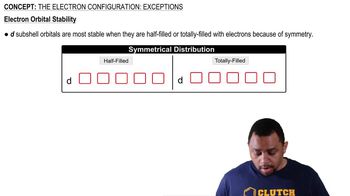
    Enhanced state achieved when subshells are either half-filled or fully filled, leading to lower energy and greater symmetry.
  • Half-Filled d Orbitals

    Configuration where each d orbital contains one electron, resulting in increased symmetry and stability.
  • Fully Filled d Orbitals

    State where all five d orbitals are occupied by two electrons each, providing maximum stability.
  • Chromium Exception

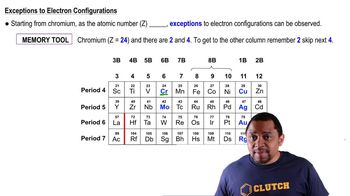
    Unique arrangement where an electron from the s orbital is promoted to the d subshell, resulting in a half-filled d5 state.
  • Copper Exception

    Configuration where an s orbital electron is promoted to the d subshell, creating a fully filled d10 state for enhanced stability.
  • Promotion

    Process where an electron moves from a lower-energy s orbital to a higher-energy d orbital to achieve greater stability.
  • Degenerate Orbitals

    Orbitals within the same subshell that possess identical energy levels, allowing for flexible electron arrangements.
  • Transition Elements

    Group of elements in the d-block of the periodic table, often exhibiting exceptions in electron configurations.
  • 4s Orbital

    First s orbital in the fourth energy level, often involved in electron promotion for stability in transition metals.
  • 3d Orbital

    Set of five orbitals in the third energy level, central to the electron configuration of transition metals.
  • Stability Enhancement

    Resulting effect when electron arrangements achieve half-filled or fully filled subshells, lowering atomic energy.