Back

Thermal Equilibrium (Simplified) quiz

Control buttons has been changed to "navigation" mode.
1/15
  • What is thermal equilibrium?

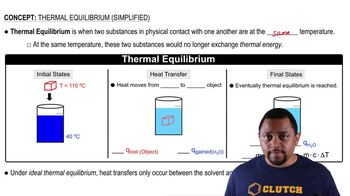
    Thermal equilibrium is when two substances in physical contact reach the same temperature and stop exchanging thermal energy.
  • In which direction does heat transfer occur between two objects?

    Heat always moves from a hotter object to a colder object.
  • What happens to the temperature of a hot object placed in colder water?

    The hot object cools off as it transfers heat to the colder water.
  • How is the sign of heat (Q) determined for an object losing heat?

    An object losing heat is assigned a negative sign for Q.
  • What sign does Q have for an object gaining heat?

    An object gaining heat has a positive sign for Q.
  • What is the relationship between the heat lost by the hot object and the heat gained by the cold object at equilibrium?

    At equilibrium, the heat lost by the hot object equals the heat gained by the cold object.
  • What equation represents the heat exchange at thermal equilibrium?

    The equation is negative mcat of the object equals positive mcat of the water.
  • What does 'mcat' stand for in the heat exchange equation?

    MCAT stands for mass (m), specific heat capacity (c), and change in temperature (ΔT).
  • What is the final temperature of both substances at thermal equilibrium?

    Both substances reach the same final temperature at thermal equilibrium.
  • Under ideal conditions, where does heat transfer occur in this scenario?

    Heat transfer occurs only between the hotter object and the colder water, with no external heat loss.
  • Why does the hot object have a negative Q value?

    The hot object has a negative Q because it is losing heat to the colder substance.
  • Why does the cold object have a positive Q value?

    The cold object has a positive Q because it is gaining heat from the hotter object.
  • What happens to heat exchange once thermal equilibrium is reached?

    Once equilibrium is reached, heat exchange between the substances stops.
  • How do you assign signs to Q for different objects in heat transfer problems?

    Assign a negative sign to Q for objects losing heat and a positive sign for objects gaining heat.
  • What is the significance of equal and opposite Q values in thermal equilibrium?

    Equal and opposite Q values indicate that the heat lost by one object is exactly gained by the other.