Back

Valence Shell Electron Pair Repulsion Theory (Simplified) quiz

Control buttons has been changed to "navigation" mode.
1/15
  • What does VSEPR theory state about the geometry of a molecule?

    VSEPR theory states that the geometry of a molecule is determined by minimizing the repulsion between electron groups on the central element.
  • What are electron groups according to VSEPR theory?

    Electron groups are the sum of lone pairs on the central element and bonding groups (surrounding elements connected to the central element).
  • How do lone pairs affect molecular geometry in VSEPR theory?

    Lone pairs contribute to repulsion due to their electron cloud, influencing the arrangement of atoms and molecular shape.
  • What is a bonding group in the context of VSEPR theory?

    A bonding group is a surrounding element that is connected to the central element.
  • How does VSEPR theory help predict molecular shapes?

    VSEPR theory predicts molecular shapes by considering the arrangement of atoms and lone pairs around the central element to minimize repulsion.
  • What is the typical range for the number of electron groups on a central element in VSEPR theory?

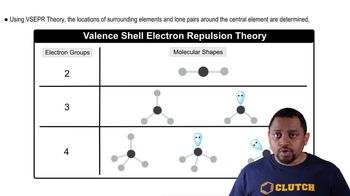
    The number of electron groups on the central element typically ranges from 2 to 4.
  • What is the arrangement when a central element has 2 electron groups?

    With 2 electron groups, the central element is connected to two surrounding elements.
  • What are the possible arrangements for a central element with 3 electron groups?

    With 3 electron groups, the central element could have three surrounding elements or two surrounding elements and one lone pair.
  • List the possible arrangements for a central element with 4 electron groups.

    With 4 electron groups, the central element could be connected to four surrounding groups, three surrounding groups and one lone pair, or two surrounding groups and two lone pairs.
  • How does the number of electron groups affect the number of possible molecular shapes?

    The more electron groups present on the central element, the more possible molecular shapes can arise.
  • Why do atoms and lone pairs space themselves out in a molecule according to VSEPR theory?

    Atoms and lone pairs space themselves out to minimize repulsion between electron groups, leading to specific molecular shapes.
  • What should you remember about the number of electron groups for basic VSEPR theory?

    You should remember electron groups of 2, 3, and 4, as these are the most common cases discussed.
  • What is the main factor that determines the locations of surrounding elements and lone pairs in a molecule?

    The main factor is the repulsion between electron groups on the central element.
  • What is the effect of lone pair electron clouds on molecular shape?

    Lone pair electron clouds increase repulsion, which can alter the arrangement of atoms and the resulting molecular shape.
  • Will the naming of molecular shapes be discussed in detail in this lesson?

    No, the naming of molecular shapes will be discussed in more detail later.