Skip to main content
Intermediate Algebra
My Course
Learn
Exam Prep
AI Tutor
Study Guides
Flashcards
Explore
Try the app
My Course
Learn
Exam Prep
AI Tutor
Study Guides
Flashcards
Explore
Try the app
Back
Solving Rational Equations in Intermediate Algebra
You can tap to flip the card.
What is the first step in solving a rational equation?
You can tap to flip the card.
👆
What is the first step in solving a rational equation?
Factor each denominator.
Track progress
Control buttons has been changed to "navigation" mode.
1/27
Recommended videos
Guided course
05:21
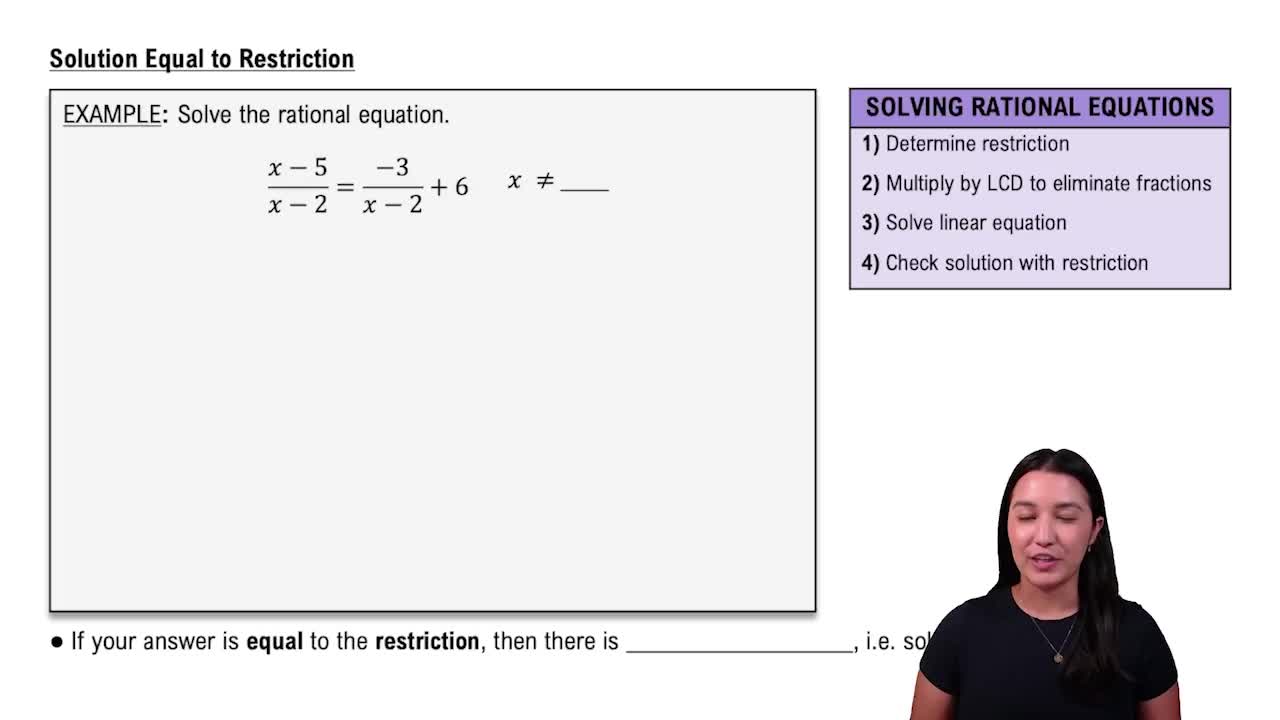
Restrictions on Rational Equations
129
views
1
rank
Guided course
08:59
Solving Rational Equations Example 1
132
views
2
rank
Guided course
05:56
Solving Rational Equations
190
views
3
rank
Terms in this set (27)
Hide definitions
What is the first step in solving a rational equation?
Factor each denominator.
What are non-permissible values (NPVs) in rational equations?
Values that make any denominator zero and must be excluded from solutions.
What is the purpose of multiplying both sides of a rational equation by the LCD?
To eliminate denominators and simplify the equation.
How do you check for extraneous solutions in rational equations?
Verify that solutions are not NPVs; if they are, reject them as extraneous.
In the equation \(\frac{x}{2} + 3 = 2 + \frac{3x}{4}\), what is the LCD?
4
What is the solution to \(\frac{x}{2} + 3 = 2 + \frac{3x}{4}\) after multiplying by the LCD and solving?
x = 4
For the equation \(\frac{2x + 3}{x + 5} + \frac{1}{2} = \frac{7}{2x + 10}\), what are the NPVs?
x ≠ -5
What is the LCD for \(\frac{2x + 3}{x + 5} + \frac{1}{2} = \frac{7}{2x + 10}\)?
2(x + 5)
What is the solution to \(\frac{2x + 3}{x + 5} + \frac{1}{2} = \frac{7}{2x + 10}\) after multiplying by the LCD and simplifying?
x = -\(\frac{4}{5}\)
How do you factor the denominator \(x^2 - 4\)?
As (x - 2)(x + 2)
What are the NPVs for the equation with denominators \(x^2 - 4\) and \(6x + 12\)?
x ≠ 2, -2
What is the LCD for denominators (x - 2)(x + 2) and 6(x + 2)?
6(x + 2)(x - 2)
What is the solution to \(\frac{2}{x^2 - 4} + \frac{10}{6x + 12} = \frac{1}{x - 2}\) after multiplying by the LCD and simplifying?
x = 5
How do you factor \(k^2 - 4\)?
As (k + 2)(k - 2)
What are the NPVs for the equation with denominator \(k^2 - 4\)?
k ≠ -2, 2
What is the LCD for denominators (k + 2), (k - 2), and (k^2 - 4)?
(k + 2)(k - 2)
After multiplying by the LCD and simplifying, what quadratic equation results from \(\frac{4k - 1}{k + 2} - \frac{k + 1}{k - 2} = \frac{k^2 - 4k + 24}{k^2 - 4}\)?
2k^2 - 8k - 24 = 0
What are the possible solutions to 2(k + 2)(k - 6) = 0?
k = -2 or k = 6
Which solution must be rejected for the equation with NPVs k ≠ -2, 2?
k = -2
What is the final solution for the equation \(\frac{4k - 1}{k + 2} - \frac{k + 1}{k - 2} = \frac{k^2 - 4k + 24}{k^2 - 4}\)?
k = 6
How do you factor \(x^2 - x - 6\)?
As (x + 2)(x - 3)
What are the NPVs for the equation with denominator \(x^2 - x - 6\)?
x ≠ -2, 3
What is the LCD for denominators (x + 2) and (x - 3)?
(x + 2)(x - 3)
What quadratic equation results from multiplying and simplifying \(\frac{3x}{x + 2} - \frac{5}{x - 3} = \frac{-25}{x^2 - x - 6}\)?
3x^2 - 14x - 15 = 0
What are the possible solutions to (3x - 5)(x - 3) = 0?
x = \(\frac{5}{3}\) or x = 3
Which solution must be rejected due to NPVs in the equation with denominators (x + 2)(x - 3)?
x = 3
What is the final solution to \(\frac{3x}{x + 2} - \frac{5}{x - 3} = \frac{-25}{x^2 - x - 6}\)?
x = \(\frac{5}{3}\)
 BackBack
 05:21