Skip to main content
Introduction to Chemistry
My Course
Learn
Exam Prep
AI Tutor
Study Guides
Flashcards
Explore
Try the app
My Course
Learn
Exam Prep
AI Tutor
Study Guides
Flashcards
Explore
Try the app
Back
Atomic, Ionic and Molecular Solids definitions
You can tap to flip the card.
Crystalline Solid
You can tap to flip the card.
👆
Crystalline Solid
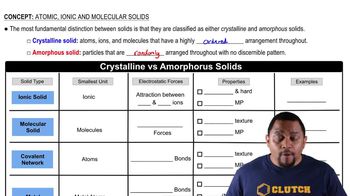
A type of solid with atoms, ions, or molecules arranged in a highly ordered, repeating pattern throughout the structure.
Track progress
Control buttons has been changed to "navigation" mode.
1/15
Related flashcards
Related practice
Recommended videos
Atomic, Ionic and Molecular Solids quiz
Atomic, Ionic and Molecular Solids
15 Terms
Atomic, Ionic and Molecular Solids
12. Liquids, Solids, and Intermolecular Forces
5 problems
Topic
Heating and Cooling Curves
12. Liquids, Solids, and Intermolecular Forces
5 problems
Topic
12. Liquids, Solids, and Intermolecular Forces
4 topics
12 problems
Chapter
Guided course
00:34
Atomic, Ionic and Molecular Solids Example 1
1681
views
7
rank
Guided course
04:14
Atomic, Ionic and Molecular Solids Concept 1
1994
views
7
rank
Terms in this set (15)
Hide definitions
Crystalline Solid
A type of solid with atoms, ions, or molecules arranged in a highly ordered, repeating pattern throughout the structure.
Amorphous Solid
A solid with randomly arranged particles, lacking a regular pattern and a distinct melting point, often able to flow slowly.
Ionic Solid
A crystalline solid composed of cations and anions held together by electrostatic attraction, typically hard, brittle, and with high melting points.
Molecular Solid
A solid made up of molecules held together by intermolecular forces, usually soft with low to moderate melting points.
Covalent Network Solid
A solid where atoms are linked by a continuous network of covalent bonds, resulting in extreme hardness and very high melting points.
Metal
A crystalline solid consisting of metal atoms bonded by different atoms' electrons, often shiny, with variable hardness and high melting points.
Electrostatic Force
The attraction between oppositely charged particles, such as cations and anions, crucial in holding certain solids together.
Intermolecular Force
A force acting between molecules, responsible for the physical properties of molecular solids like softness and melting point.
Covalent Bond
A strong connection formed by the sharing of electron pairs between atoms, forming the backbone of certain very hard solids.
Luster
A property describing how a solid reflects light, often resulting in a shiny appearance, especially in metals.
Polymers
Large molecules made of repeating units, often found in amorphous solids like plastics, contributing manshapes and properties.
Melting Point
The temperature at which a solid transitions to a liquid; can be high, low, or undefined depending on the solid's structure.
Brittleness
A tendency of a solid to break or shatter without significant deformation, commonly seen in ionic solids.
Hardness
A measure of a solid's resistance to scratching substance, varying widely among different types of solids.
Flow
The unusual ability of some solids, especially amorphous ones, to move or deform slowly over time, resembling liquid behavior.
 BackBack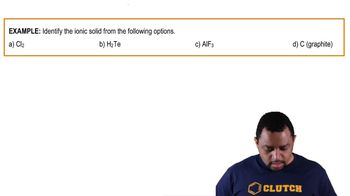
 00:34
00:34