Skip to main content
Introduction to Chemistry
My Course
Learn
Exam Prep
AI Tutor
Study Guides
Flashcards
Explore
Try the app
My Course
Learn
Exam Prep
AI Tutor
Study Guides
Flashcards
Explore
Try the app
Back
Atomic Theory definitions
You can tap to flip the card.
Atom
You can tap to flip the card.
👆
Atom
Smallest unit of matter retaining chemical properties, once thought indivisible but now known to contain subatomic particles.
Track progress
Control buttons has been changed to "navigation" mode.
1/15
Related flashcards
Related practice
Recommended videos
Atomic Theory quiz #1
Atomic Theory
20 Terms
Atomic Theory
4. Atoms and Elements
5 problems
Topic
Rutherford Gold Foil Experiment
4. Atoms and Elements
2 problems
Topic
4. Atoms and Elements - Part 1 of 2
12 topics
34 problems
Chapter
4. Atoms and Elements - Part 2 of 2
1 topic
3 problems
Chapter
Guided course
05:22
Atomic Theory
9821
views
93
rank
Guided course
01:48
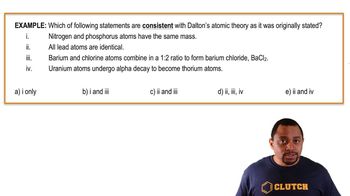
Atomic Theory Example 1
8007
views
64
rank
Terms in this set (15)
Hide definitions
Atom
Smallest unit of matter retaining chemical properties, once thought indivisible but now known to contain subatomic particles.
Atomic Theory
Scientific explanation describing the nature, behavior, and structure of matter at the atomic level.
Democritus
Ancient Greek philosopher who first proposed the existence of indivisible particles making up matter.
John Dalton
Early 19th-century scientist who formulated foundational principles about the composition and behavior of atoms.
Postulate
Fundamental assumption or principle forming the basis of a scientific theory, such as those in Dalton’s model.
Subatomic Particle
Component found within atoms, including protons, neutrons, and electrons, not known in Dalton’s era.
Proton
Positively charged particle located in the nucleus, determining the atomic number of an element.
Neutron
Electrically neutral particle in the atomic nucleus, contributing to atomic mass and isotope formation.
Electron
Negatively charged particle orbiting the nucleus, responsible for chemical bonding and reactivity.
Isotope
Variant of an element’s atom with the same number of protons but different numbers of neutrons.
Compound
Substance formed from two or more different atoms chemically combined in specific ratios.
Chemical Reaction
Process involving the rearrangement of atoms, resulting in new substances without creating or destroying matter.
Conservation of Mass
Principle stating that matter cannot be created or destroyed, only transformed during chemical changes.
Element
Pure substance consisting of only one type of atom, defined by its number of protons.
Mass Number
Sum of protons and neutrons in an atom’s nucleus, distinguishing isotopes of the same element.
 BackBack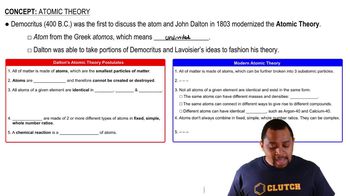
 05:22
05:22